Problem27
Section 12.3: The Most General Applications of Bernoulli's Equation

Question

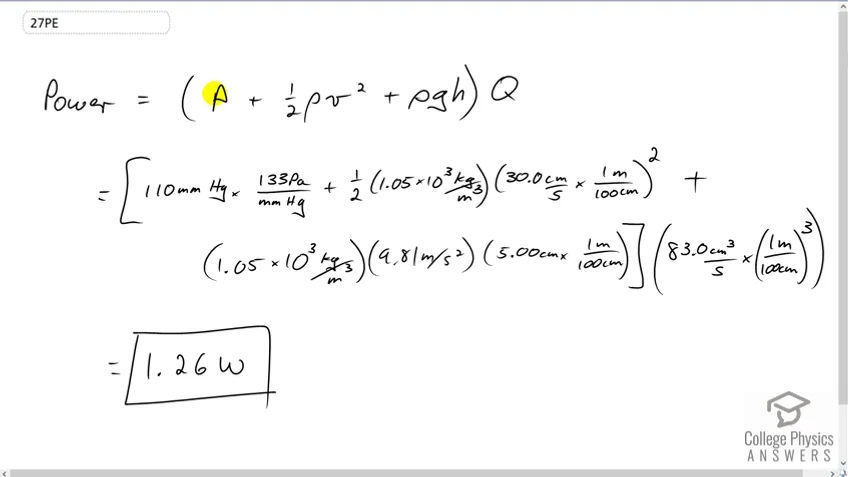
The left ventricle of a resting adult's heart pumps blood at a flow rate of , increasing its pressure by 110mm Hg, its speed from zero to 30.0 cm/s, and its height by 5.00 cm. (All numbers are averaged over the entire heartbeat.) Calculate the total power output of the left ventricle. Note that most of the power is used to increase blood pressure.

Question by OpenStax is licensed under CC BY 4.0

Final Answer

1.26 W1.26 \textrm{ W}

Solution video

1:18
Watch this solution with a 7-day free trial
Full access to every solution — cancel anytime · Already a subscriber? Log in
Start free trial →
4.7 (3)
210 views

Calculator Screenshots

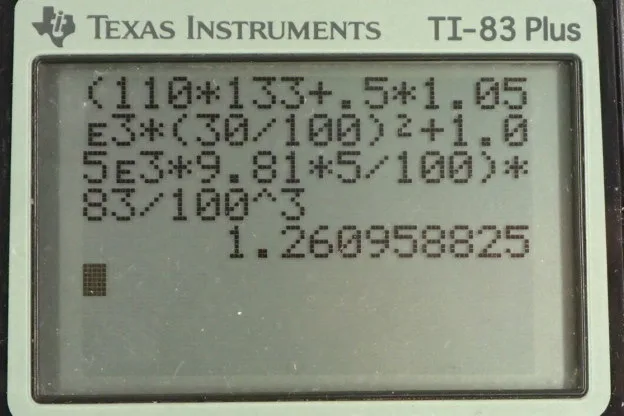
Calculator screenshot

Video Transcript

This is College Physics Answers with Shaun Dychko. We'll find the power of the left ventricle of the heart by multiplying Bernoulli's Equation by the volume flow rate of blood. And so the pressure that the left ventricle gives to the blood is 110 millimeters of Mercury which we converted to pascals by multiplying 133 pascals for every millimeter of Mercury. Then, add to that this term that results from the speed that the left ventricle gives to the blood. So it's changing speed, it goes from zero to 30 centimeters per second which we convert into meters per second by multiplying by one meter for every hundred centimeters, then times by the density of blood which is 1.05 times ten to the three kilograms per cubic meter times a half and we square the speed. And then we add to it this additional term resulting from the height change of the blood on average, five centimeters converted into meters multiplied by g and then multiplied by density of blood. Then all this gets multiplied by 83 cubic centimeters per second volume flow rate which we also convert by multiplying by one meter for every hundred centimeters and we do that three times. And this gives 1.26 is the power output of the left ventricle of the heart, 1.26 watts.

Comments

SnowCatMacDobhran·
I think you might have been tripped by TI's goofiness and not enough parenthesis. [P + 1/2 ro v^2 + ro gh]Q = power convert to mks Q = 83 cm^3/s * (1m/100cm)^3=8.3E-5 m^3/s v1 = 30 cm/s = 0.3 m/s h = 5 cm = 0.05 m P = 110 mmHg * 133Pa = 146.3 1/2 ro v^2 = 0.5*1.05E3*(0.3^2)= 47.25 ro gh = 1.05E3*9.8*0.05 = 514.5 [146.3+47.25+514.5](8.3E-5)=0.0587
Like
ShaunDychko·
Hi, thanks for sharing your feedback. I'm thinking the answer is correct since the answer you arrive at, 59mW, seems like an unrealistically low power output for the heart. The conversion of pressure to pascals should be 14,630 Pa, not 146.3 Pa. All the best, Shaun
Like
SnowCatMacDobhran·
:eyeroll:: ::sigh:: basic math fails me.
Like
ShaunDychko·
No worries!
Like