Question
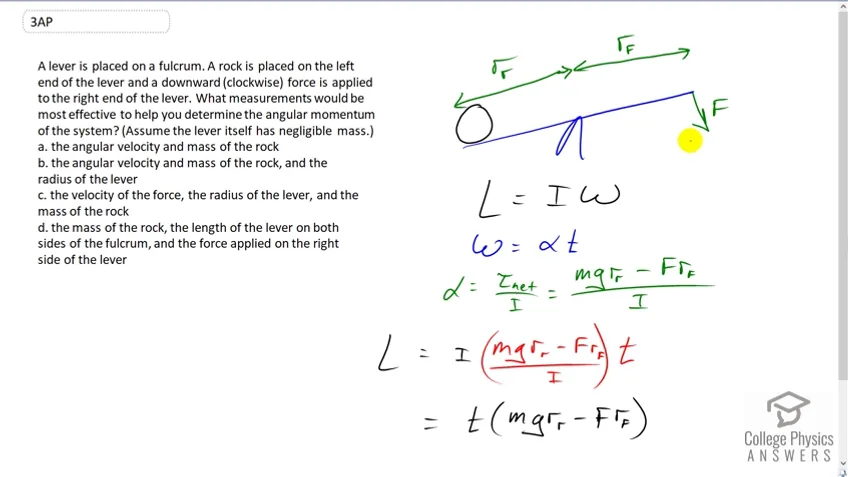
A lever is placed on a fulcrum. A rock is placed on the left end of the lever and a downward (clockwise) force is applied to the right end of the lever. What measurements would be most effective to help you determine the angular momentum of the system? (Assume the lever itself has negligible mass.) (a) the angular velocity and mass of the rock
(b) the angular velocity and mass of the rock, and the radius of the lever
(c) the velocity of the force, the radius of the lever, and the mass of the rock
(d) the mass of the rock, the length of the lever on both sides of the fulcrum, and the force applied on the right side of the lever
Final Answer
(d)
Solution video

This is a 26-second preview. Get access to the full video by starting your free 7-day trial.
This is a 26-second preview. Get access to the full video by starting your free 7-day trial.
Video Transcript
This is College Physics Answers with Shaun Dychko. We have a lever resting on a fulcrum. On one end is a rock and on the other end is a force being applied clockwise. So the question asks us for the angular momentum of the system. Now, the angular momentum is going to change with time probably, if the torque exerted by the force is significantly bigger than the torque exerted by the rock. So we have a time factor in our angular momentum formula. Let's start here. We have the angular momentum is moment of inertia multiplied by angular velocity. This angular velocity will depend on what time we're considering and it's going to be the time multiplied by the angular acceleration. Angular acceleration is the the net torque divided by moment of inertia and so the net torque is the counter-clockwise torque due to the force of gravity on the rock. So that will be m g multiplied by the rock's lever arm where it's distance from the fulcrum and then subtract from that the torque due to this applied force which is going to be the force magnitude multiplied by the lever arm of the force where it's distance from the fulcrum. Then we divide by that by moment of inertia i and we'll substitute that in for alpha and then we have t as well here, all being substituted in for omega here. The moment of inertia cancels there and we're left with the angular momentum is time multiplied by mass of the rock times g times the rock's lever arm, minus the force times the force's lever arm. So we need to choose an option here that has all these things in it. We need the mass of the rock, the distance from the rock to the fulcrum, we need the force and we need the distance from the force to the fulcrum. So that's option D, mass of the rock, length of the lever on both sides of the fulcrum, and the force applied. There we go!
Comments
No comments yet.