Problem5
Section 10.2: Kinematics of Rotational Motion

Question

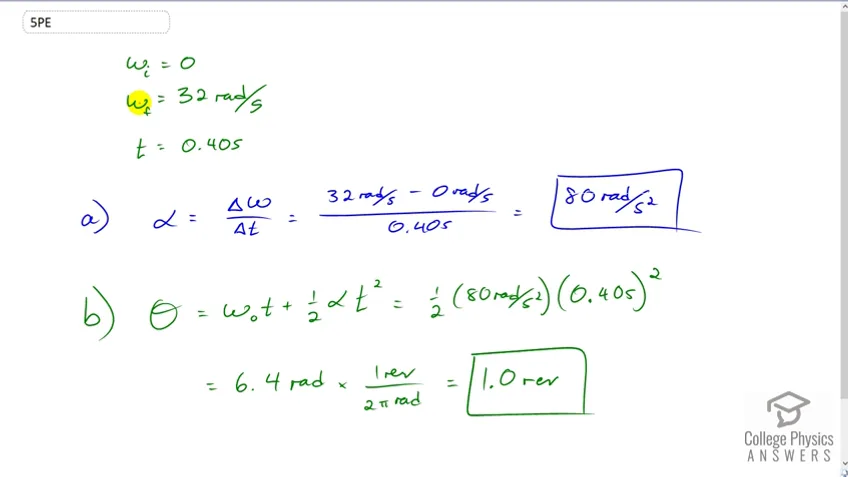
With the aid of a string, a gyroscope is accelerated from rest to 32 rad/s in 0.40 s. (a) What is its angular acceleration in rad/s2? (b) How many revolutions does it go through in the process?

Question by OpenStax is licensed under CC BY 4.0

Final Answer

a) 80 rad/s280 \textrm{ rad/s}^2

b) 1.0 rev1.0 \textrm{ rev}

Solution video

1:00

This is a 16-second preview. Get access to the full video by starting your free 7-day trial.

4.0 (15)
821 views

Calculator Screenshots

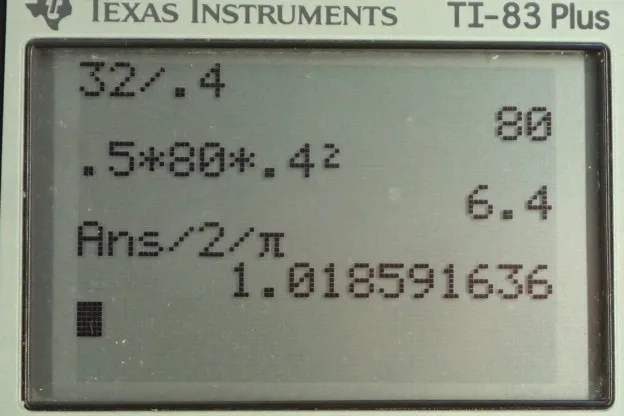
Calculator screenshot

Video Transcript

This is College Physics Answers with Shaun Dychko. The initial speed of the gyroscope is zero and its final speed is 32 radians per second and it achieves this change in angular velocity in a time of 0.4 seconds. So its angular acceleration is that change in angular velocity divided by time. 32 radians per second final minus zero initial angular velocity divided by 0.4 seconds gives 80 radians per second squared angular acceleration. The number of revolutions that it does in this time of 0.4 seconds is given by this formula and the initial angular velocity is zero so that term disappears and so we have one half times angular acceleration times time squared. So that's one half times 80, times 0.4 seconds squared giving us 6.4 radians of angular displacement. Now we want to know the number of revolutions so we multiply the radians by one revolution for every two pi radians and we get 1.0 revolutions.

Comments

emailcwspam·
On the calculator screenshot, I see you divided 6.4/2/pi, instead of 6.4/2pi. What's the reason for that?
Like
ShaunDychko·
Hello, thank you for the question. 6.4/2/pi is the same as 6.4/(2pi) (I think you meant to put the brackets around the denominator, which is important). The calculator evaluates left to right, so it answers 6.4/2 first, then takes that answer and divides by pi, which gives the same result as 6.4/(2pi) but with fewer button pushes on the calculator since I don't need to enter the brackets. It's just a button saving efficiency -- a personal preference in other words. Consider an example with easier numbers: 12/4/3 becomes 3 / 3 when the calculator first evaluates 12/4, and the final answer is 1. Compare this with 12/(4*3) = 12/12 = 1, just the same, but with extra button pushing. The calculator evaluates left to right with operators of equal precedence (like division/multiplication). Hope this helps, Shaun
Like
emailcwspam·
That helps, thank you! I forgot to bracket my 2pi.
Like
ShaunDychko·
You're welcome!
Like