Chapter 8: Linear Momentum and Collisions
113 problems solved · Free preview of every solution shows how it’s started · Watch the full videos with a free 7-day trial →


8.1 Linear Momentum and Force
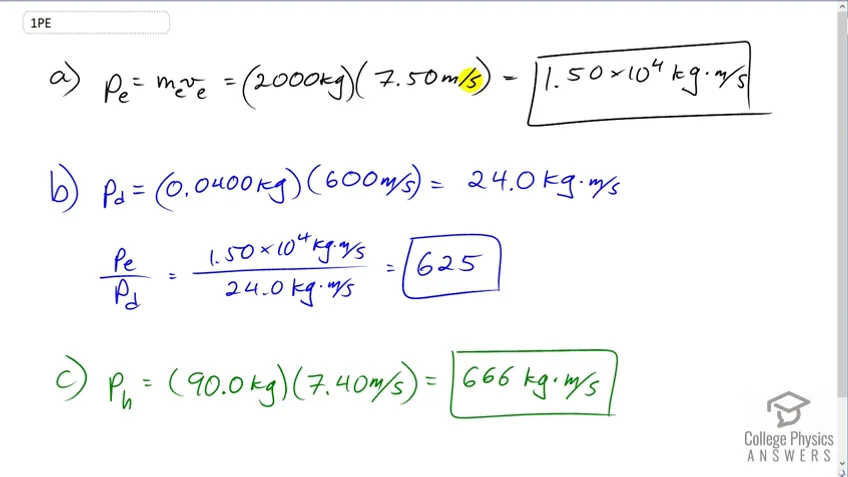 1:35Problem 1Free(a) Calculate the momentum of a 2000-kg elephant charging a hunter at a speed of . (b) Compare the elephant’s momentum with the momentum of a 0.0400-kg tranquilizer dart fired at a speed of . (c) What is the momentum of the 90.0-kg hunter running at after missing the elephant?
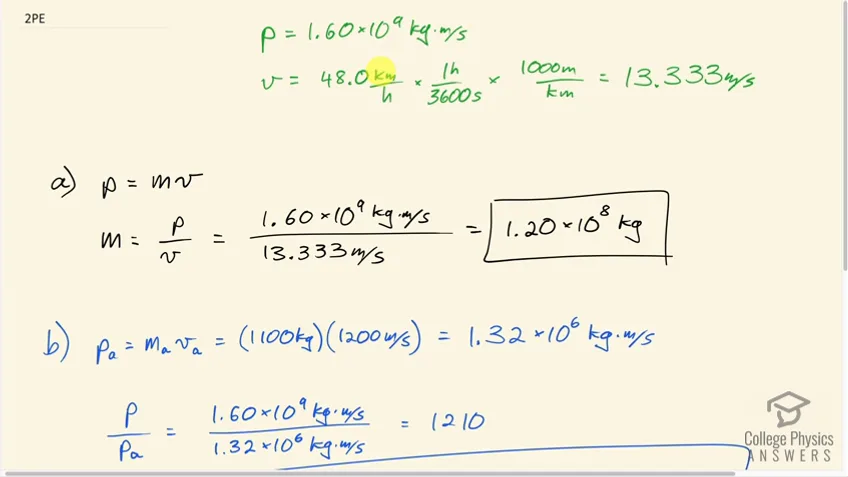 1:59PreviewProblem 2Full video with free trial(a) What is the mass of a large ship that has a momentum of , when the ship is moving at a speed of 48.0 km/h? (b) Compare the ship’s momentum to the momentum of a 1100-kg artillery shell fired at a speed of 1200 m/s .
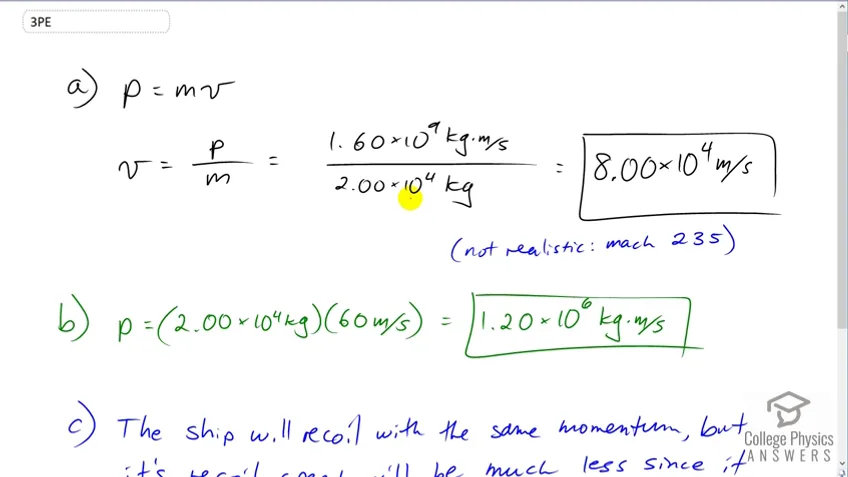 1:20PreviewProblem 3Full video with free trial(a) At what speed would a airplane have to fly to have a momentum of (the same as the ship’s momentum in the problem above)? (b) What is the plane’s momentum when it is taking off at a speed of ? (c) If the ship is an aircraft carrier that launches these airplanes with a catapult, discuss the implications of your answer to (b) as it relates to recoil effects of the catapult on the ship.
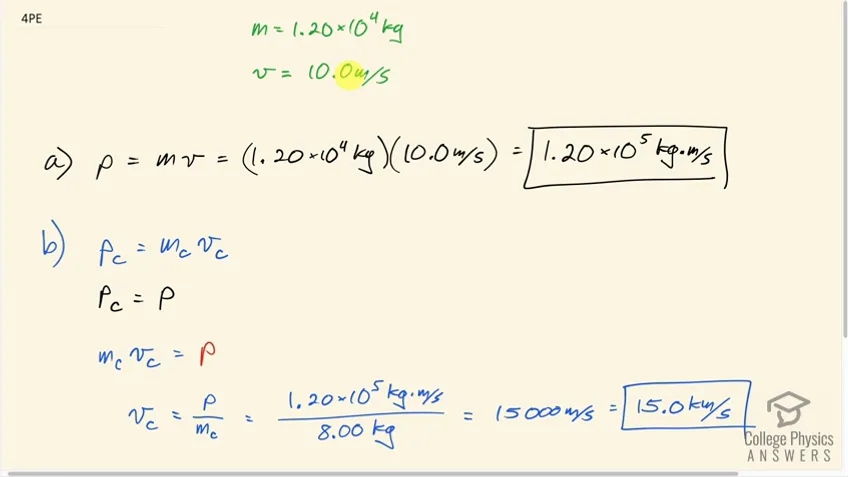 1:03PreviewProblem 4Full video with free trial(a) What is the momentum of a garbage truck that is and is moving at 10.0 m/s ? (b) At what speed would an 8.00-kg trash can have the same momentum as the truck?
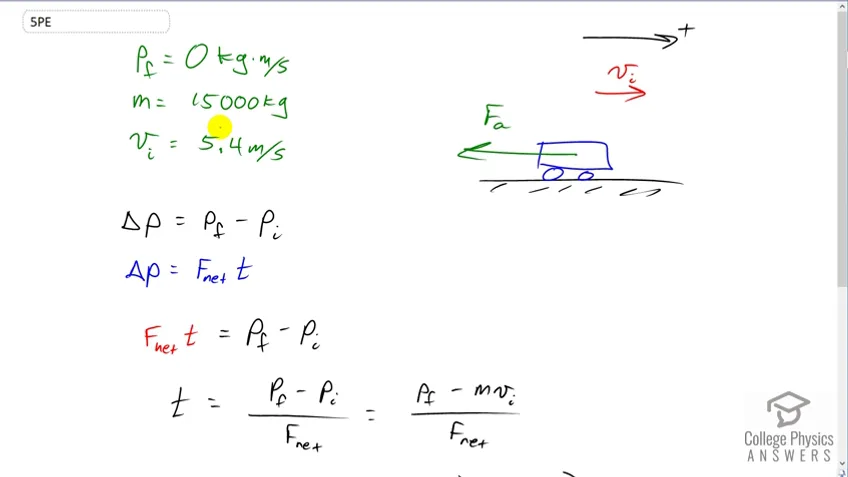 1:45PreviewProblem 5Full video with free trialA runaway train car that has a mass of 15,000 kg travels at a speed of down a track. Compute the time required for a force of 1500 N to bring the car to rest.
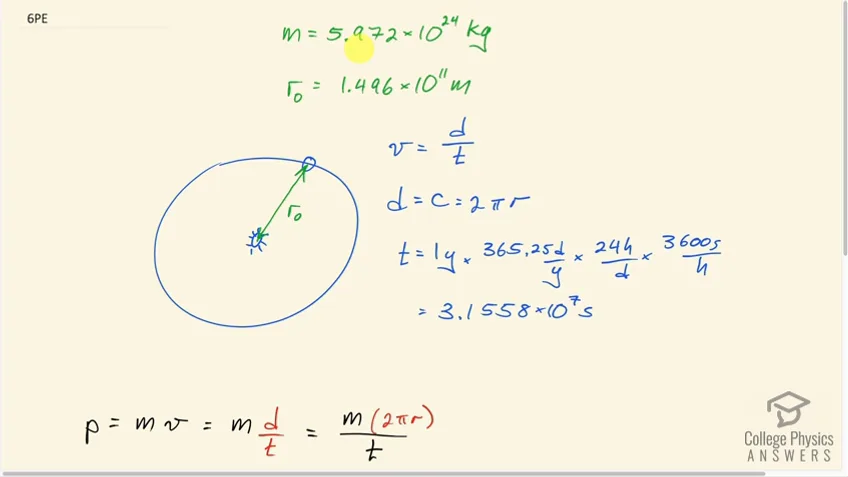 1:09PreviewProblem 6Full video with free trialThe mass of Earth is and its orbital radius is an average of . Calculate its linear momentum.
8.2 Impulse
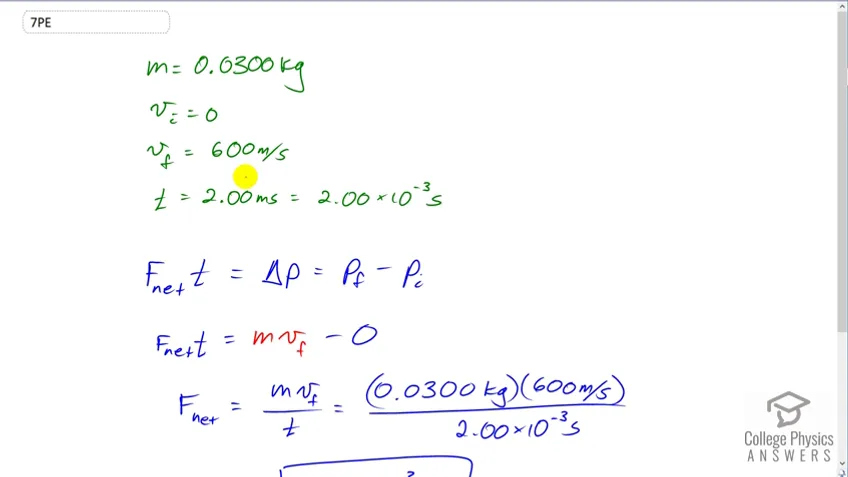 1:15PreviewProblem 7Full video with free trialA bullet is accelerated down the barrel of a gun by hot gases produced in the combustion of gun powder. What is the average force exerted on a 0.0300-kg bullet to accelerate it to a speed of 600 m/s in a time of 2.00 ms (milliseconds)?
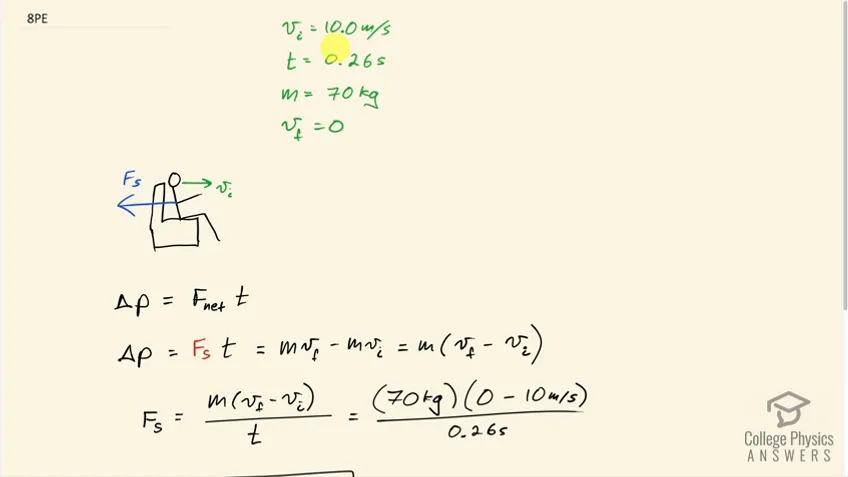 1:59PreviewProblem 8Full video with free trialA car moving at 10 m/s crashes into a tree and stops in 0.26 s. Calculate the force the seat belt exerts on a passenger in the car to bring him to a halt. The mass of the passenger is 70 kg.
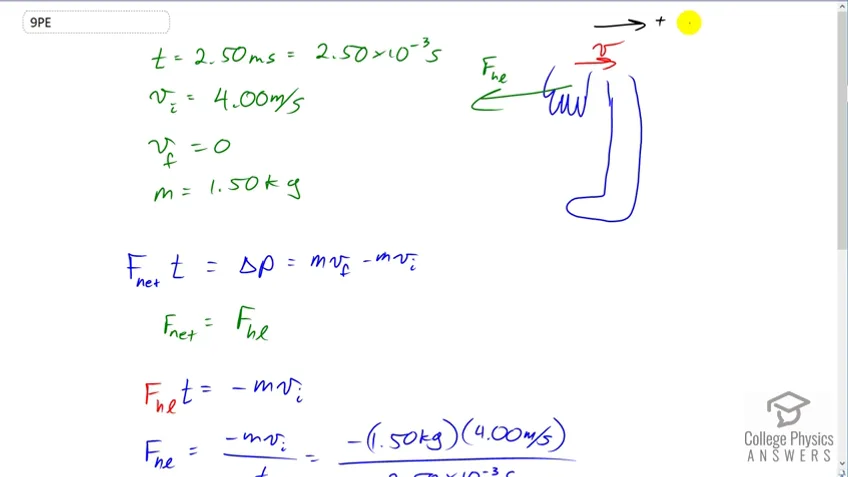 2:40PreviewProblem 9Full video with free trialA person slaps her leg with her hand, bringing her hand to rest in 2.50 milliseconds from an initial speed of 4.00 m/s. (a) What is the average force exerted on the leg, taking the effective mass of the hand and forearm to be 1.50 kg? (b) Would the force be any different if the woman clapped her hands together at the same speed and brought them to rest in the same time? Explain why or why not.
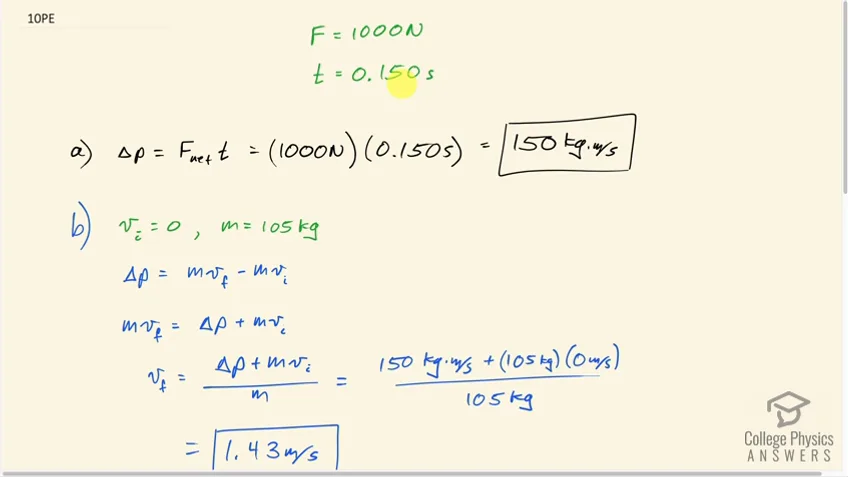 2:51PreviewProblem 10Full video with free trialA professional boxer hits his opponent with a 1000-N horizontal blow that lasts for 0.150 s. (a) Calculate the impulse imparted by this blow. (b) What is the opponent’s final velocity, if his mass is 105 kg and he is motionless in midair when struck near his center of mass? (c) Calculate the recoil velocity of the opponent’s 10.0-kg head if hit in this manner, assuming the head does not initially transfer significant momentum to the boxer’s body. (d) Discuss the implications of your answers for parts (b) and (c).
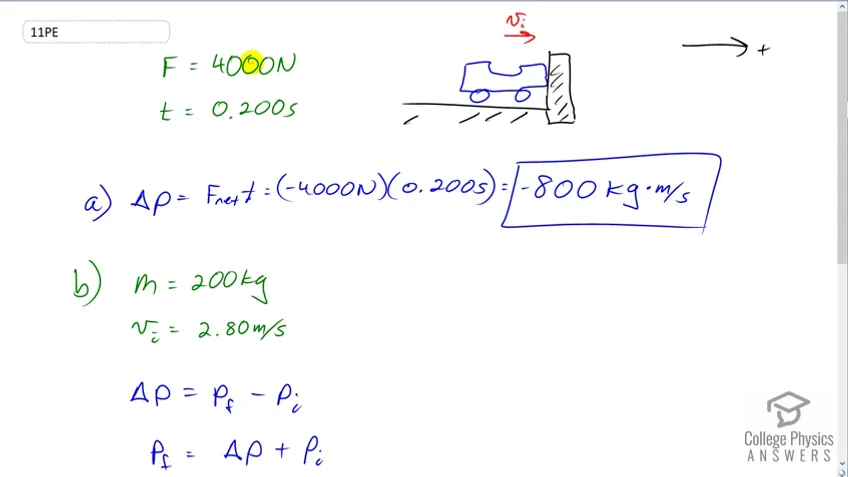 1:57PreviewProblem 11Full video with free trialSuppose a child drives a bumper car head on into the side rail, which exerts a force of 4000 N on the car for 0.200 s. (a) What impulse is imparted by this force? (b) Find the final velocity of the bumper car if its initial velocity was 2.80 m/s and the car plus driver have a mass of 200 kg. You may neglect friction between the car and floor.
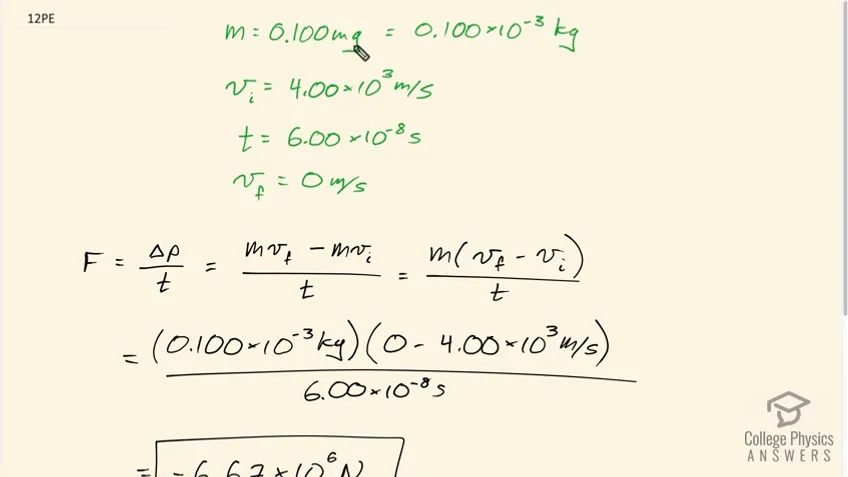 2:01PreviewProblem 12Full video with free trialOne hazard of space travel is debris left by previous missions. There are several thousand objects orbiting Earth that are large enough to be detected by radar, but there are far greater numbers of very small objects, such as flakes of paint. Calculate the force exerted by a 0.100-mg chip of paint that strikes a spacecraft window at a relative speed of , given the collision lasts .
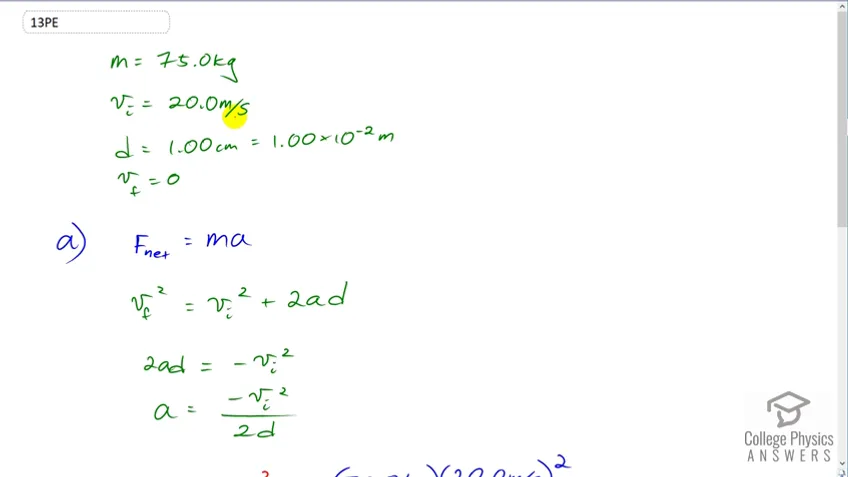 2:18PreviewProblem 13Full video with free trialA 75.0-kg person is riding in a car moving at 20.0 m/s when the car runs into a bridge abutment. (a) Calculate the average force on the person if he is stopped by a padded dashboard that compresses an average of 1.00 cm. (b) Calculate the average force on the person if he is stopped by an air bag that compresses an average of 15.0 cm.
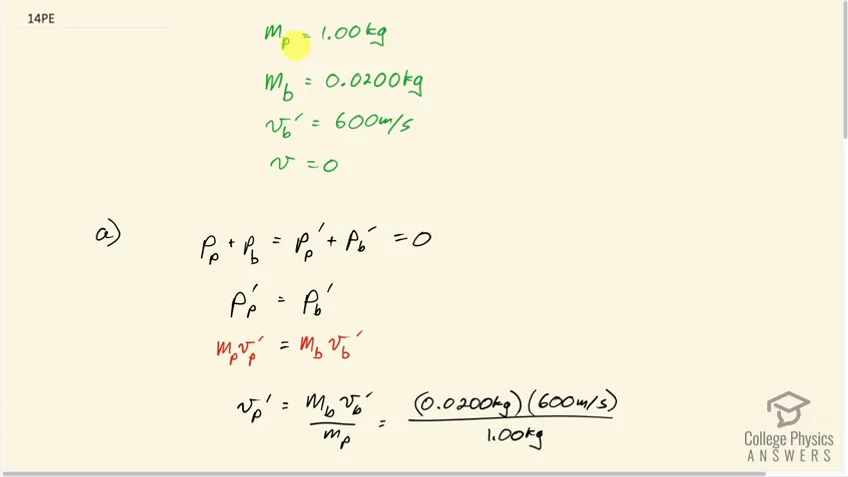 4:46PreviewProblem 14Full video with free trialMilitary rifles have a mechanism for reducing the recoil forces of the gun on the person firing it. An internal part recoils over a relatively large distance and is stopped by damping mechanisms in the gun. The larger distance reduces the average force needed to stop the internal part. (a) Calculate the recoil velocity of a 1.00-kg plunger that directly interacts with a 0.0200-kg bullet fired at 600 m/s from the gun. (b) If this part is stopped over a distance of 20.0 cm, what average force is exerted upon it by the gun? (c) Compare this to the force exerted on the gun if the bullet is accelerated to its velocity in 10.0 ms (milliseconds).
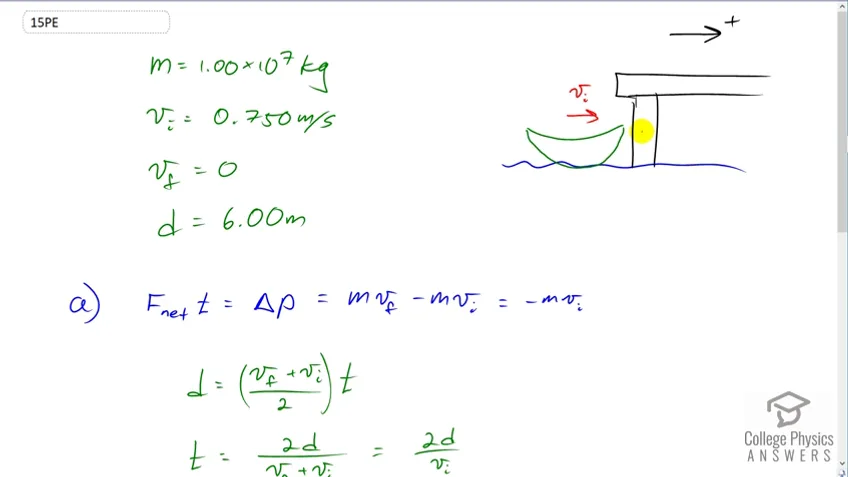 3:05PreviewProblem 15Full video with free trialA cruise ship with a mass of strikes a pier at a speed of 0.750 m/s. It comes to rest 6.00 m later, damaging the ship, the pier, and the tugboat captain’s finances. Calculate the average force exerted on the pier using the concept of impulse. (Hint: First calculate the time it took to bring the ship to rest.)
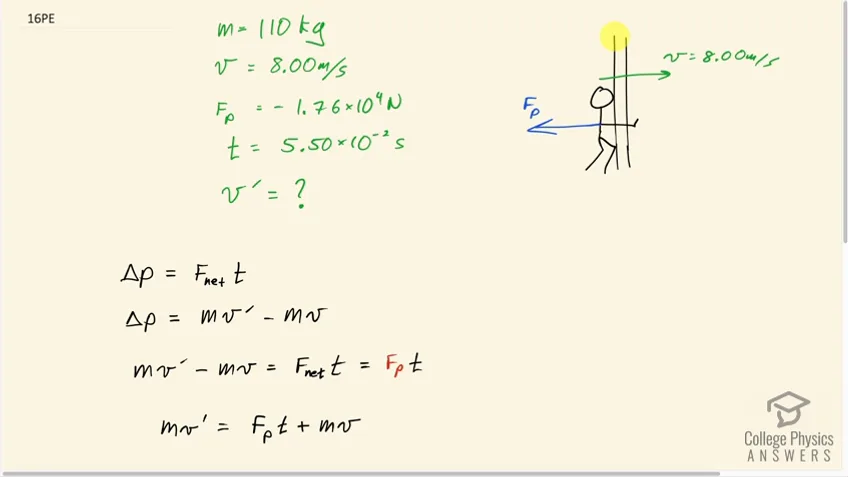 2:15PreviewProblem 16Full video with free trialCalculate the final speed of a 110-kg rugby player who is initially running at 8.00 m/s but collides head-on with a padded goalpost and experiences a backward force of for .
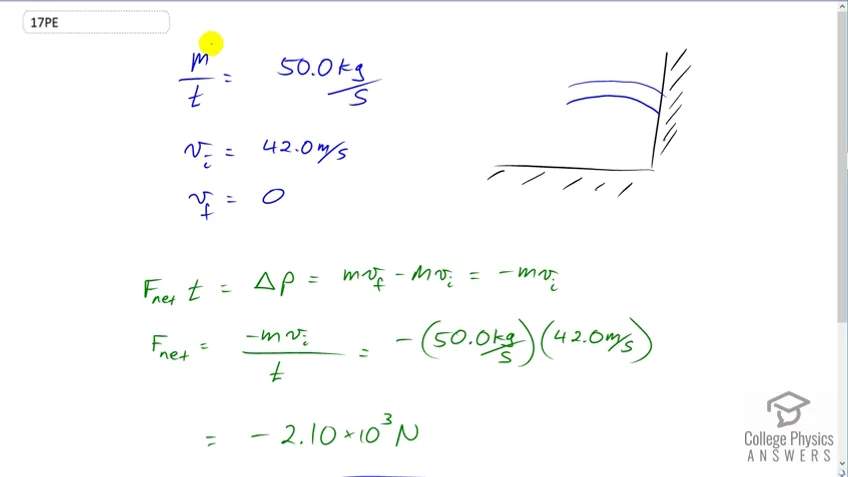 1:56PreviewProblem 17Full video with free trialWater from a fire hose is directed horizontally against a wall at a rate of 50.0 kg/s and a speed of 42.0 m/s. Calculate the magnitude of the force exerted on the wall, assuming the water’s horizontal momentum is reduced to zero.
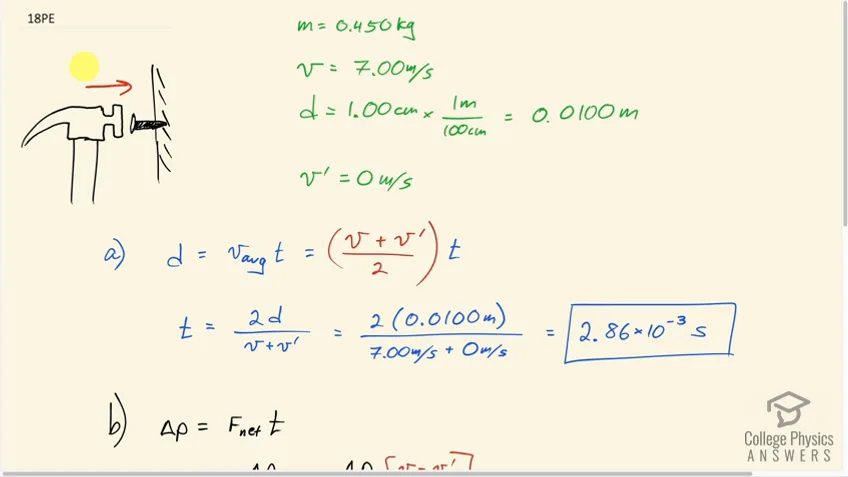 4:09PreviewProblem 18Full video with free trialA 0.450-kg hammer is moving horizontally at 7.00 m/s when it strikes a nail and comes to rest after driving the nail 1.00 cm into a board. (a) Calculate the duration of the impact. (b) What was the average force exerted on the nail?
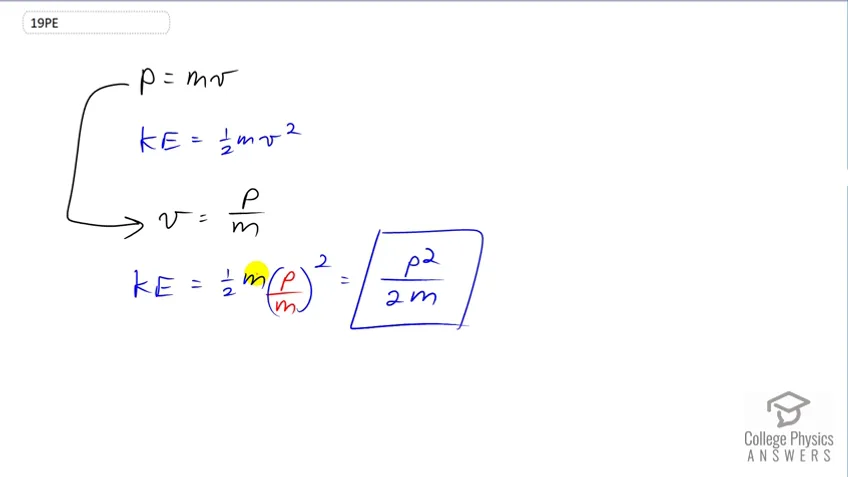 2:01PreviewProblem 19Full video with free trialStarting with the definitions of momentum and kinetic energy, derive an equation for the kinetic energy of a particle expressed as a function of its momentum.
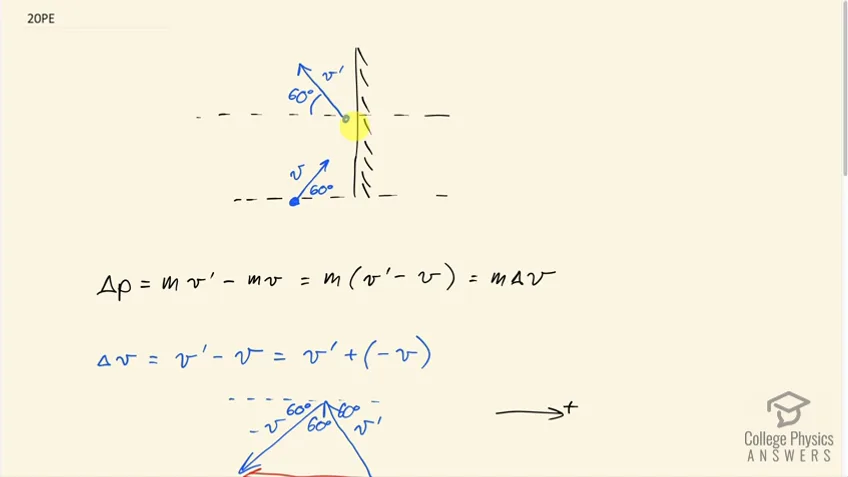 5:53PreviewProblem 20Full video with free trialA ball with an initial velocity of 10 m/s moves at an angle above the direction. The ball hits a vertical wall and bounces off so that it is moving above the direction with the same speed. What is the impulse delivered by the wall?
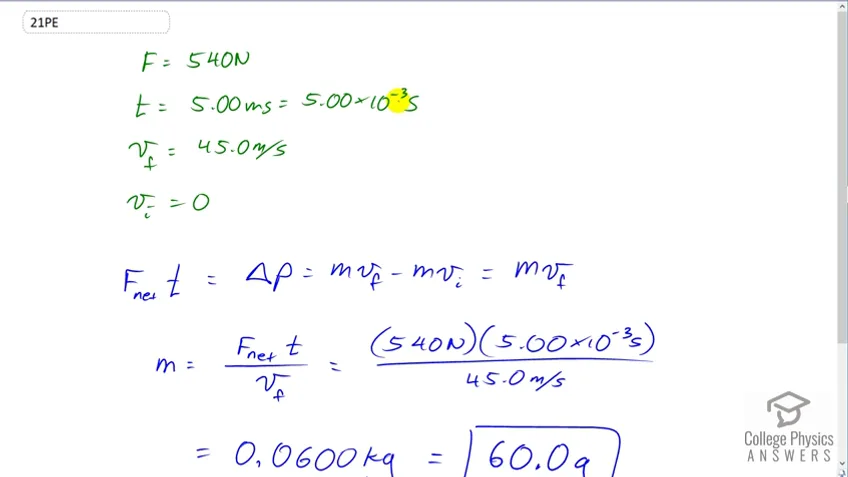 1:14PreviewProblem 21Full video with free trialWhen serving a tennis ball, a player hits the ball when its velocity is zero (at the highest point of a vertical toss). The racquet exerts a force of 540 N on the ball for 5.00 ms, giving it a final velocity of 45.0 m/s. Using these data, find the mass of the ball.
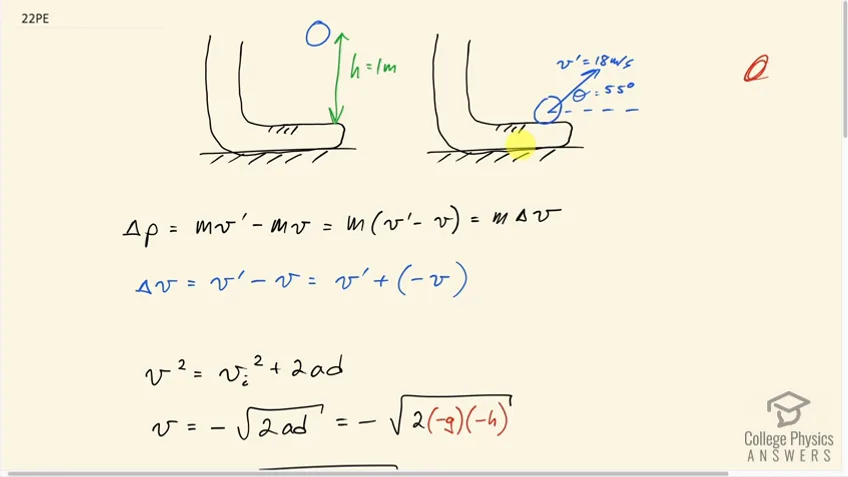 7:16PreviewProblem 22Full video with free trialA punter drops a ball from rest vertically 1 meter down onto his foot. The ball leaves the foot with a speed of 18 m/s at an angle above the horizontal. What is the impulse delivered by the foot (magnitude and direction)?
8.3 Conservation of Momentum
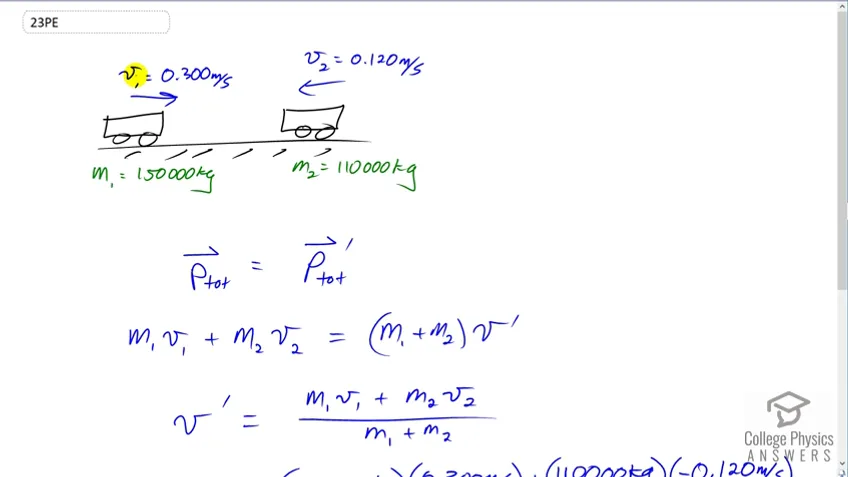 2:04PreviewProblem 23Full video with free trialTrain cars are coupled together by being bumped into one another. Suppose two loaded train cars are moving toward one another, the first having a mass of 150,000 kg and a velocity of 0.300 m/s, and the second having a mass of 110,000 kg and a velocity of . (The minus indicates direction of motion.) What is their final velocity?
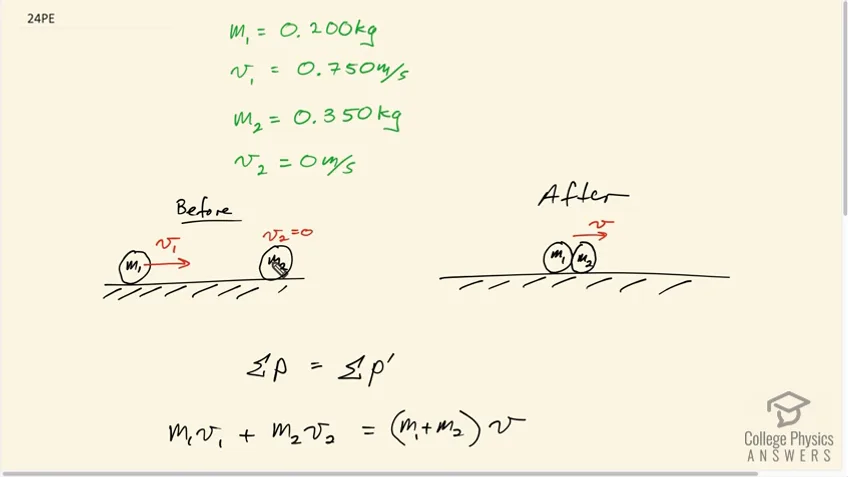 1:51PreviewProblem 24Full video with free trialSuppose a clay model of a koala bear has a mass of 0.200 kg and slides on ice at a speed of 0.750 m/s. It runs into another clay model, which is initially motionless and has a mass of 0.350 kg. Both being soft clay, they naturally stick together. What is their final velocity?
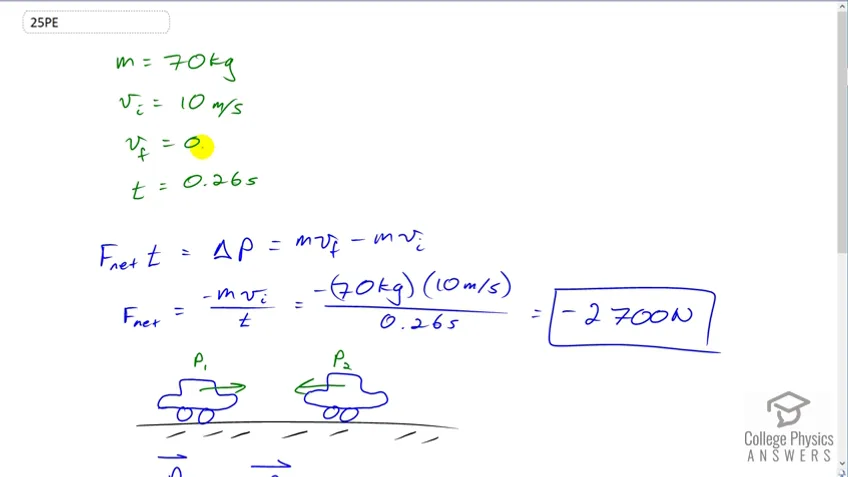 2:46PreviewProblem 25Full video with free trialConsider the following question: A car moving at 10 m/s crashes into a tree and stops in 0.26 s. Calculate the force the seatbelt exerts on a passenger in the car to bring him to a halt. The mass of the passenger is 70 kg. Would the answer to this question be different if the car with the 70-kg passenger had collided with a car that has a mass equal to and is traveling in the opposite direction and at the same speed? Explain your answer.
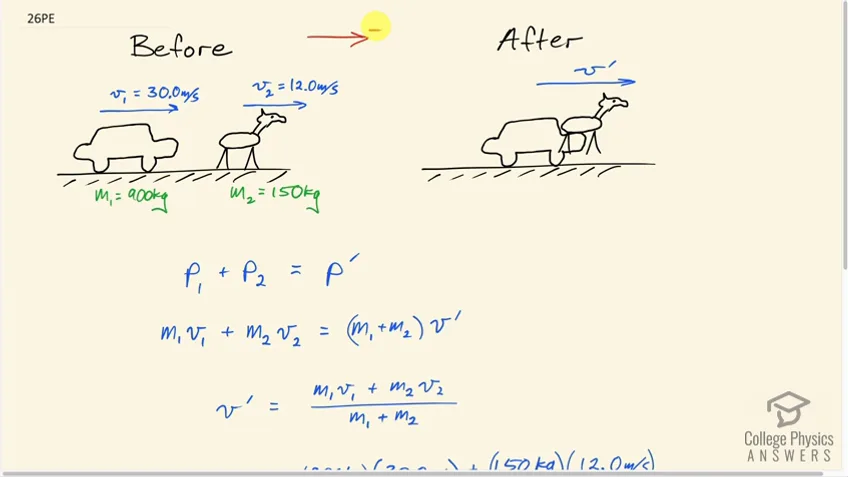 1:43PreviewProblem 26Full video with free trialWhat is the velocity of a 900-kg car initially moving at 30.0 m/s, just after it hits a 150-kg deer initially running at 12.0 m/s in the same direction? Assume the deer remains on the car.
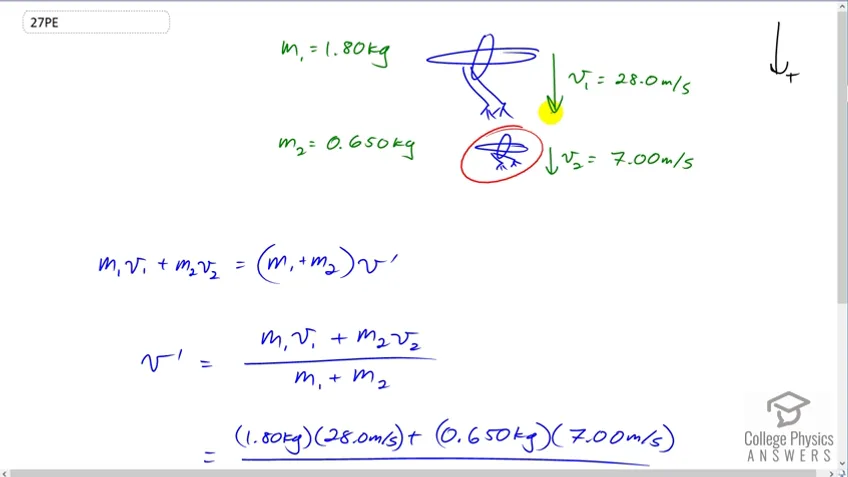 1:32PreviewProblem 27Full video with free trialA 1.80-kg falcon catches a 0.650-kg dove from behind in midair. What is their velocity after impact if the falcon’s velocity is initially 28.0 m/s and the dove’s velocity is 7.00 m/s in the same direction?
8.4 Elastic Collisions in One Dimension
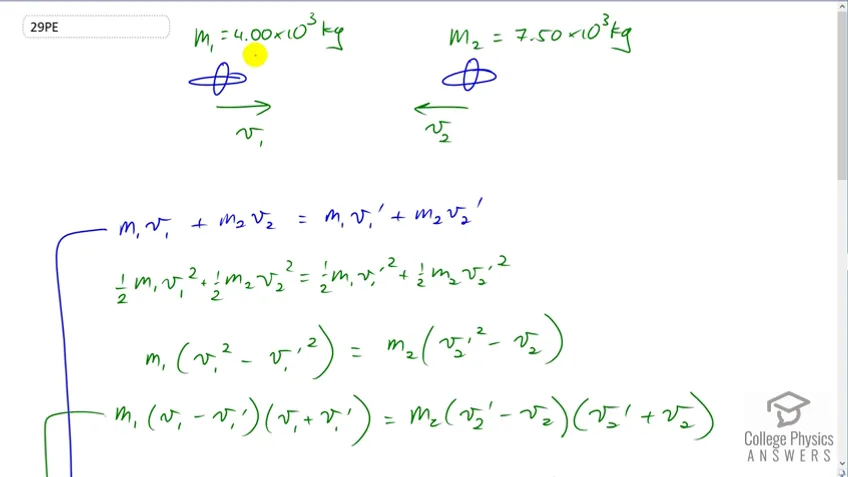 7:41PreviewProblem 29Full video with free trialTwo piloted satellites approach one another at a relative speed of 0.250 m/s, intending to dock. The first has a mass of , and the second a mass of . If the two satellites collide elastically rather than dock, what is their final relative velocity?
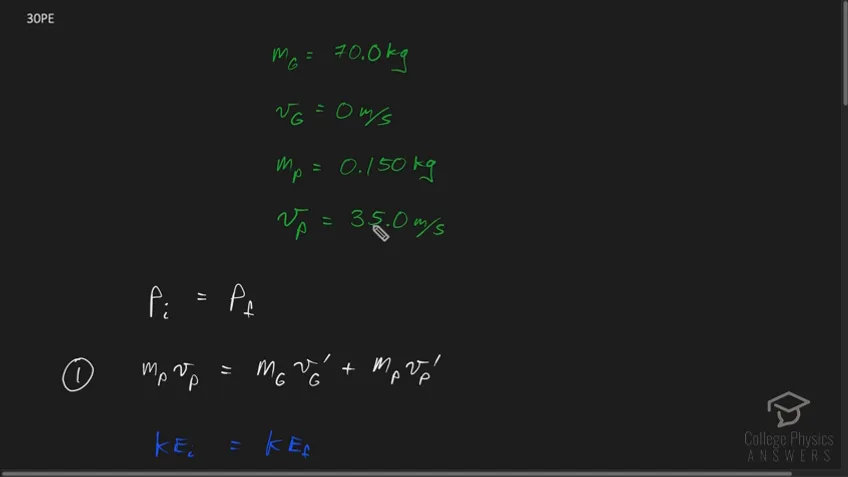 8:25PreviewProblem 30Full video with free trialA 70.0-kg ice hockey goalie, originally at rest, catches a 0.150-kg hockey puck slapped at him at a velocity of 35.0 m/ s. Suppose the goalie and the ice puck have an elastic collision and the puck is reflected back in the direction from which it came. What would their final velocities be in this case?
8.5 Inelastic Collisions in One Dimension
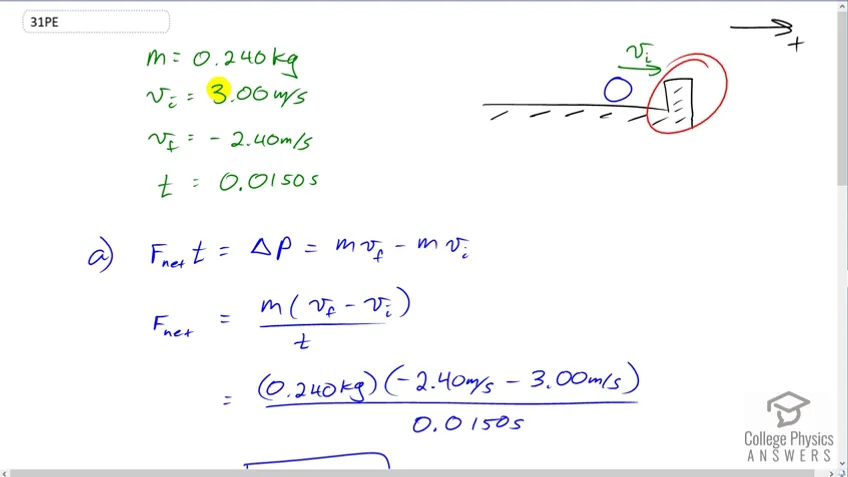 2:37PreviewProblem 31Full video with free trialA 0.240-kg billiard ball that is moving at 3.00 m/s strikes the bumper of a pool table and bounces straight back at 2.40 m/s (80% of its original speed). The collision lasts 0.0150 s. (a) Calculate the average force exerted on the ball by the bumper. (b) How much kinetic energy in joules is lost during the collision? (c) What percent of the original energy is left?
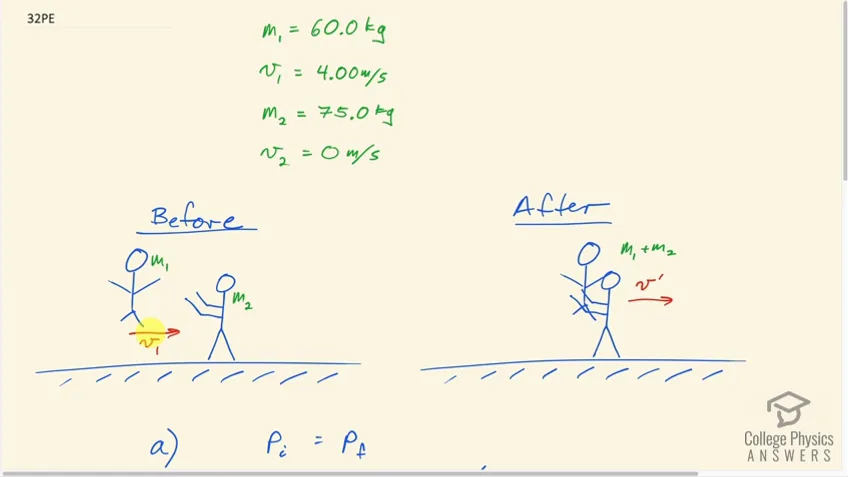 2:43PreviewProblem 32Full video with free trialDuring an ice show, a 60.0-kg skater leaps into the air and is caught by an initially stationary 75.0-kg skater. (a) What is their final velocity assuming negligible friction and that the 60.0-kg skater’s original horizontal velocity is 4.00 m/s? (b) How much kinetic energy is lost?
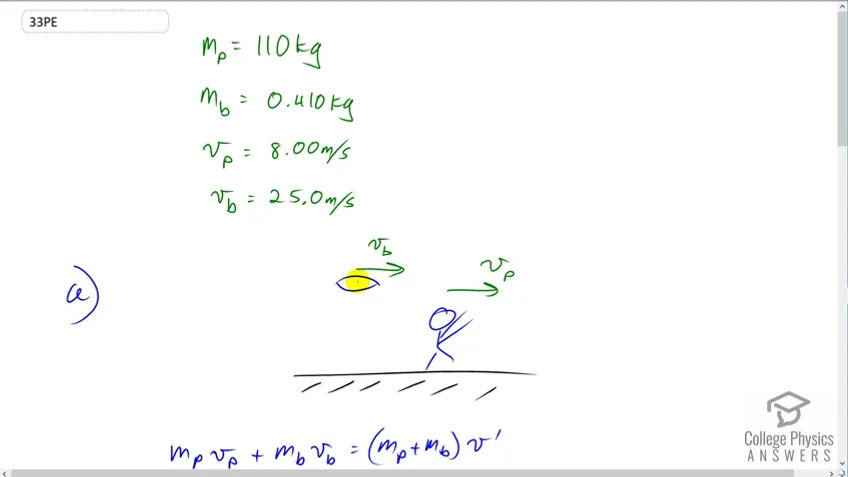 4:01PreviewProblem 33Full video with free trialUsing mass and speed data from Example 8.1 and assuming that the football player catches the ball with his feet off the ground with both of them moving horizontally, calculate: (a) the final velocity if the ball and player are going in the same direction and (b) the loss of kinetic energy in this case. (c) Repeat parts (a) and (b) for the situation in which the ball and the player are going in opposite directions. Might the loss of kinetic energy be related to how much it hurts to catch the pass?
Example 8.1:
(a) Calculate the momentum of a 110-kg football player running at 8.00 m/s. (b) Compare the player’s momentum with the momentum of a hard-thrown 0.410-kg football that has a speed of 25.0 m/s.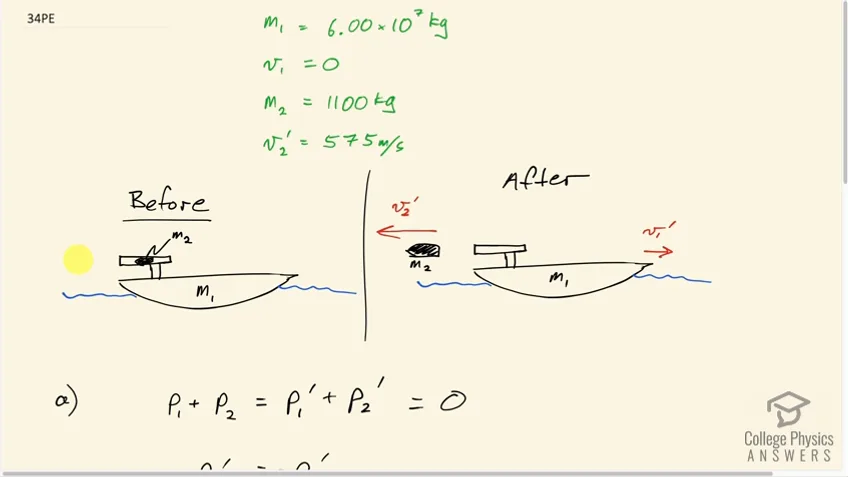 3:42PreviewProblem 34Full video with free trialA battleship that is and is originally at rest fires a 1100-kg artillery shell horizontally with a velocity of 575 m/s. (a) If the shell is fired straight aft (toward the rear of the ship), there will be negligible friction opposing the ship’s recoil. Calculate its recoil velocity. (b) Calculate the increase in internal kinetic energy (that is, for the ship and the shell). This energy is less than the energy released by the gun powder—significant heat transfer occurs.
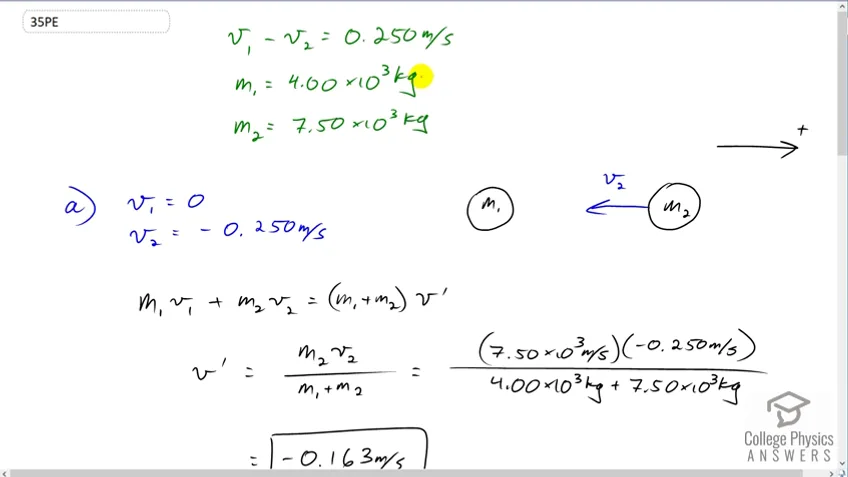 6:59PreviewProblem 35Full video with free trialTwo piloted satellites approaching one another, at a relative speed of 0.250 m/s, intending to dock. The first has a mass of , and the second a mass of . (a) Calculate the final velocity (after docking) by using the frame of reference in which the first satellite was originally at rest. (b) What is the loss of kinetic energy in this inelastic collision? (c) Repeat both parts by using the frame of reference in which the second satellite was originally at rest. Explain why the change in velocity is different in the two frames, whereas the change in kinetic energy is the same in both.
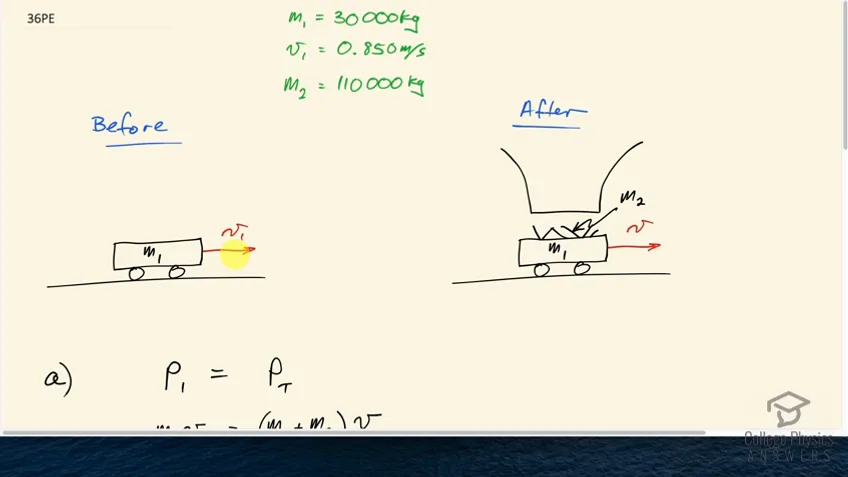 2:38PreviewProblem 36Full video with free trialA 30,000-kg freight car is coasting at 0.850 m/s with negligible friction under a hopper that dumps 110,000 kg of scrap metal into it. (a) What is the final velocity of the loaded freight car? (b) How much kinetic energy is lost?
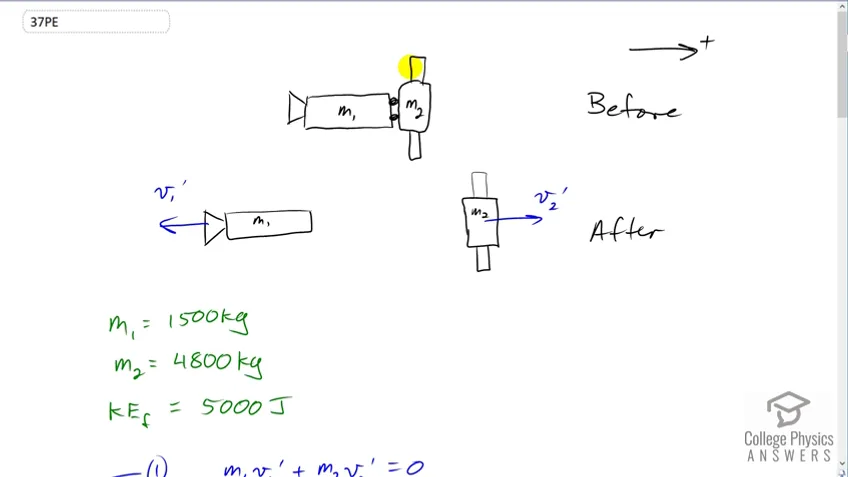 7:26PreviewProblem 37Full video with free trialSpace probes may be separated from their launchers by exploding bolts. (They bolt away from one another.) Suppose a 4800-kg satellite uses this method to separate from the 1500-kg remains of its launcher, and that 5000 J of kinetic energy is supplied to the two parts. What are their subsequent velocities using the frame of reference in which they were at rest before separation?
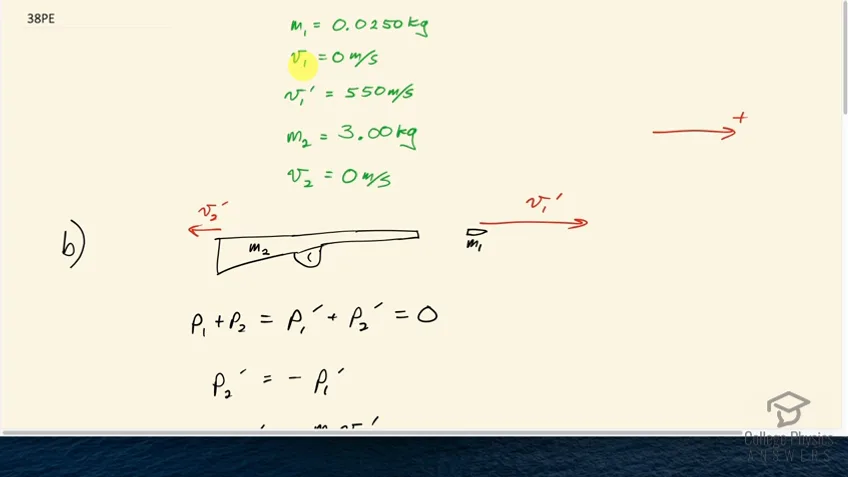 4:50PreviewProblem 38Full video with free trialA 0.0250-kg bullet is accelerated from rest to a speed of 550 m/s in a 3.00-kg rifle. The pain of the rifle’s kick is much worse if you hold the gun loosely a few centimeters from your shoulder rather than holding it tightly against your shoulder. (a) Calculate the recoil velocity of the rifle if it is held loosely away from the shoulder. (b) How much kinetic energy does the rifle gain? (c) What is the recoil velocity if the rifle is held tightly against the shoulder, making the effective mass 28.0 kg? (d) How much kinetic energy is transferred to the rifle- shoulder combination? The pain is related to the amount of kinetic energy, which is significantly less in this latter situation. (e) Calculate the momentum of a 110-kg football player running at 8.00 m/s. Compare the player’s momentum with the momentum of a hard-thrown 0.410-kg football that has a speed of 25.0 m/s. Discuss its relationship to this problem.
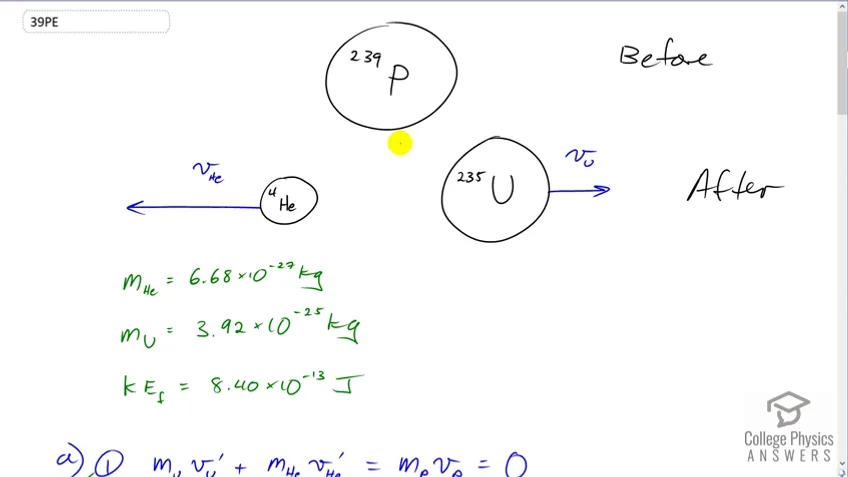 6:39PreviewProblem 39Full video with free trialOne of the waste products of a nuclear reactor is plutonium-239 . This nucleus is radioactive and decays by splitting into a helium-4 nucleus and a uranium-235 nucleus , the latter of which is also radioactive and will itself decay some time later. The energy emitted in the plutonium decay is and is entirely converted to kinetic energy of the helium and uranium nuclei. The mass of the helium nucleus is , while that of the uranium is (note that the ratio of the masses is 4 to 235). (a) Calculate the velocities of the two nuclei, assuming the plutonium nucleus is originally at rest. (b) How much kinetic energy does each nucleus carry away? Note that the data given here are accurate to three digits only.
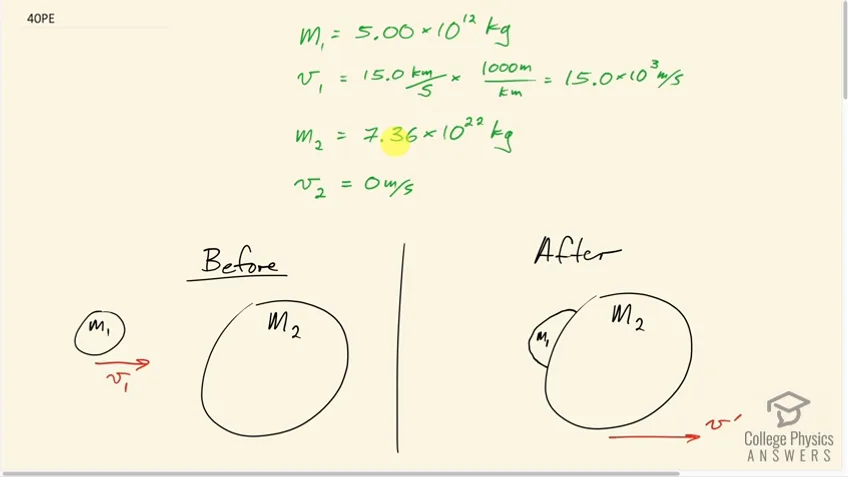 3:53PreviewProblem 40Full video with free trialThe Moon’s craters are remnants of meteorite collisions. Suppose a fairly large asteroid that has a mass of (about a kilometer across) strikes the Moon at a speed of 15.0 km/s. (a) At what speed does the Moon recoil after the perfectly inelastic collision (the mass of the Moon is ) ? (b) How much kinetic energy is lost in the collision? Such an event may have been observed by medieval English monks who reported observing a red glow and subsequent haze about the Moon. (c) In October 2009, NASA crashed a rocket into the Moon, and analyzed the plume produced by the impact. (Significant amounts of water were detected.) Answer part (a) and (b) for this real-life experiment. The mass of the rocket was 2000 kg and its speed upon impact was 9000 km/h. How does the plume produced alter these results?
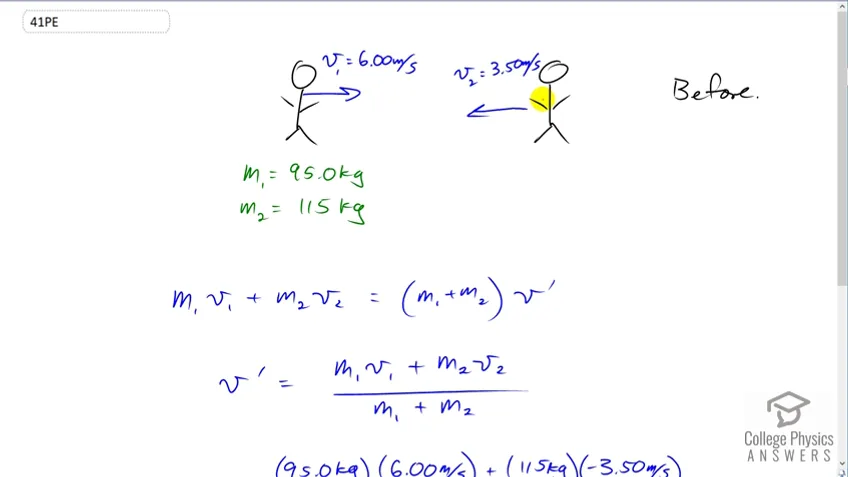 1:29PreviewProblem 41Full video with free trialTwo football players collide head-on in midair while trying to catch a thrown football. The first player is 95.0 kg and has an initial velocity of 6.00 m/s, while the second player is 115 kg and has an initial velocity of –3.50 m/s. What is their velocity just after impact if they cling together?
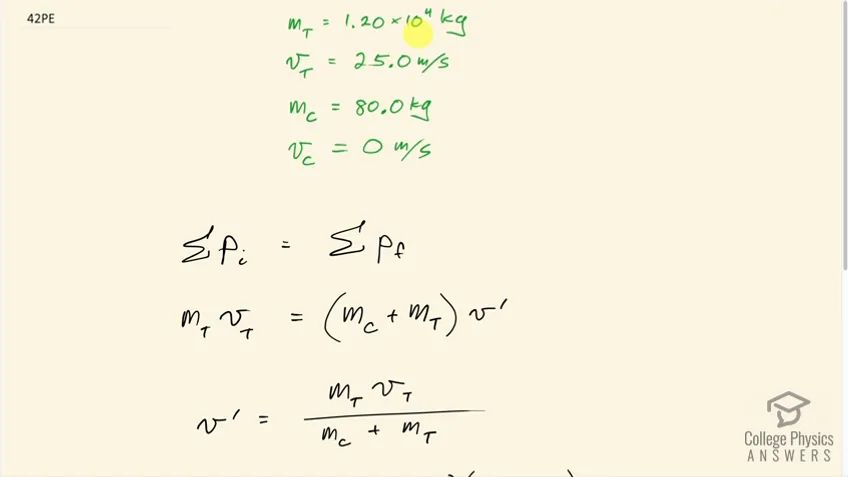 1:25PreviewProblem 42Full video with free trialWhat is the speed of a garbage truck that is and is initially moving at 25.0 m/s just after it hits and adheres to a trash can that is 80.0 kg and is initially at rest?
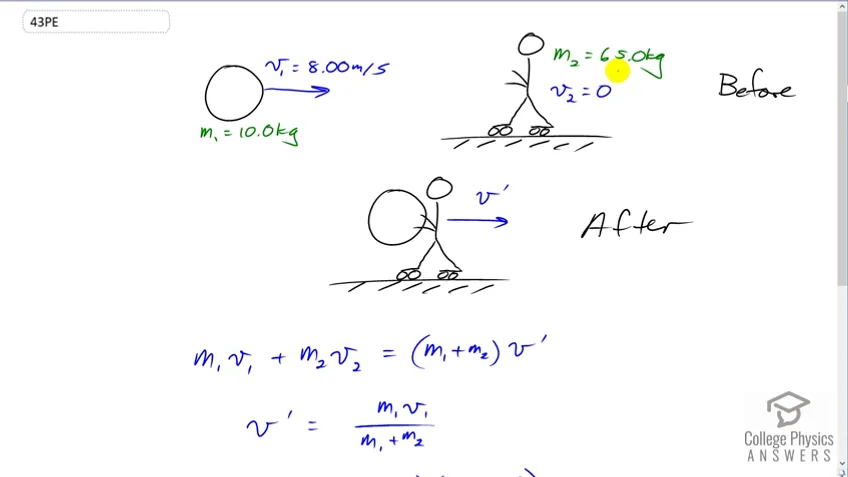 1:18PreviewProblem 43Full video with free trialDuring a circus act, an elderly performer thrills the crowd by catching a cannon ball shot at him. The cannon ball has a mass of 10.0 kg and the horizontal component of its velocity is 8.00 m/s when the 65.0-kg performer catches it. If the performer is on nearly frictionless roller skates, what is his recoil velocity?
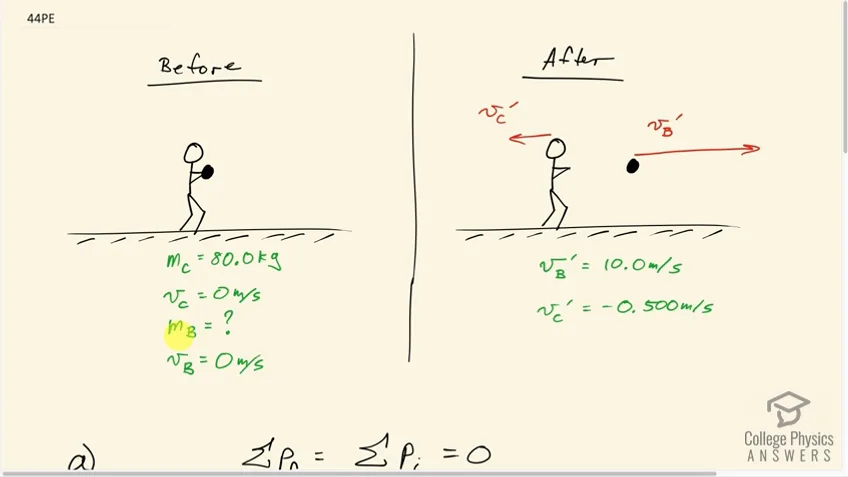 2:22PreviewProblem 44Full video with free trial(a) During an ice skating performance, an initially motionless 80.0-kg clown throws a fake barbell away. The clown’s ice skates allow her to recoil frictionlessly. If the clown recoils with a velocity of 0.500 m/s and the barbell is thrown with a velocity of 10.0 m/s, what is the mass of the barbell? (b) How much kinetic energy is gained by this maneuver? (c) Where does the kinetic energy come from?
8.6 Collisions of Point Masses in Two Dimensions
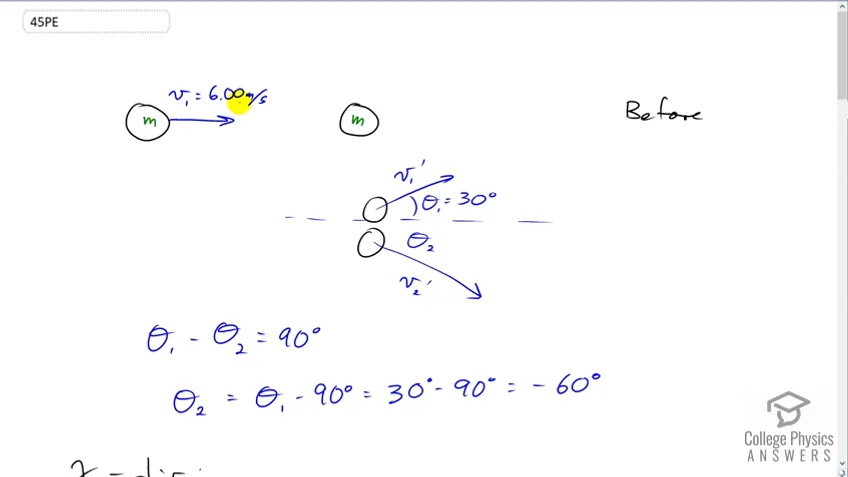 7:33PreviewProblem 45Full video with free trialTwo identical pucks collide on an air hockey table. One puck was originally at rest. (a) If the incoming puck has a speed of 6.00 m/s and scatters to an angle of , what is the velocity (magnitude and direction) of the second puck? (You may use the result that for elastic collisions of objects that have identical masses.) (b) Confirm that the collision is elastic.
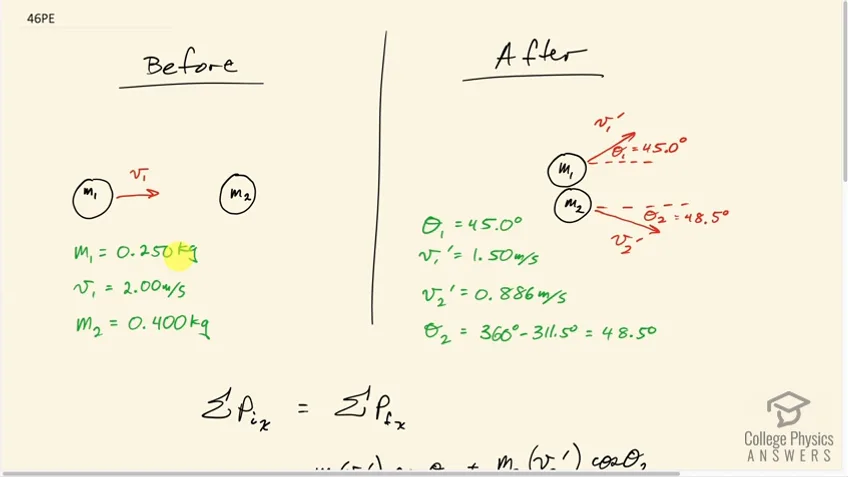 4:28PreviewProblem 46Full video with free trialConfirm that the results of the example Example 8.7 do conserve momentum in both the x - and y -directions.
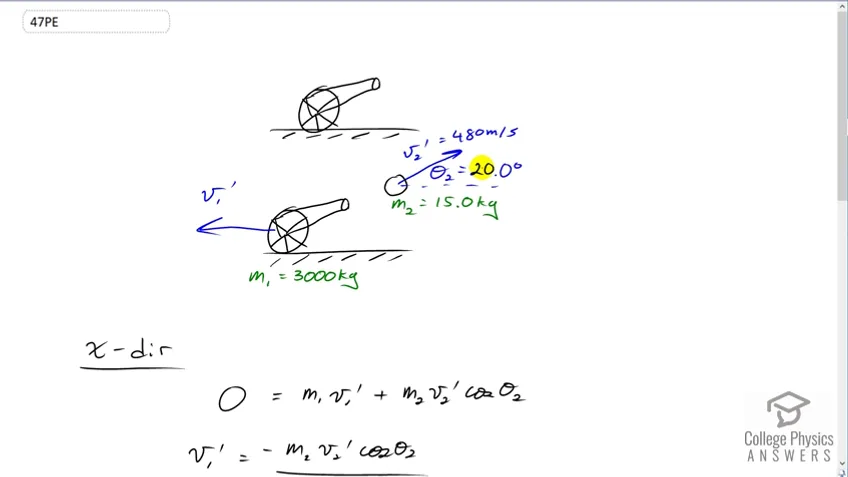 2:08PreviewProblem 47Full video with free trialA 3000-kg cannon is mounted so that it can recoil only in the horizontal direction. (a) Calculate its recoil velocity when it fires a 15.0-kg shell at 480 m/s at an angle of above the horizontal. (b) What is the kinetic energy of the cannon? This energy is dissipated as heat transfer in shock absorbers that stop its recoil. (c) What happens to the vertical component of momentum that is imparted to the cannon when it is fired?
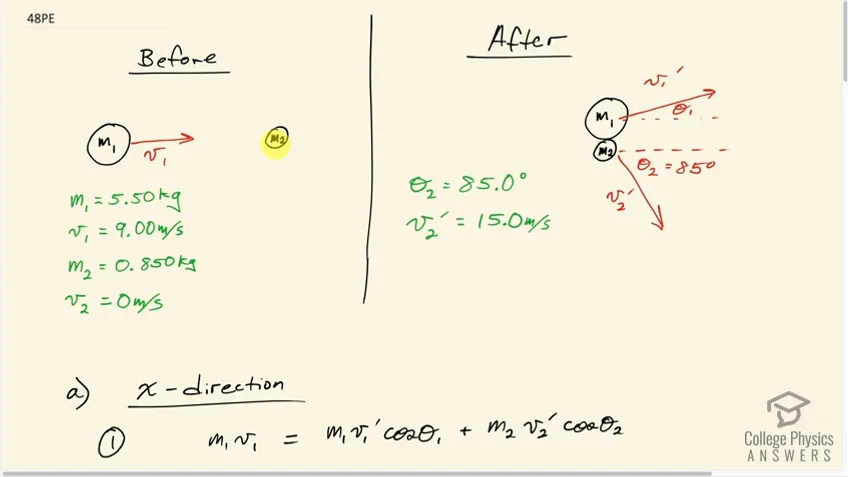 10:09PreviewProblem 48Full video with free trialA 5.50-kg bowling ball moving at 9.00 m/s collides with a 0.850-kg bowling pin, which is scattered at an angle of to the initial direction of the bowling ball and with a speed of 15.0 m/s. (a) Calculate the final velocity (magnitude and direction) of the bowling ball. (b) Is the collision elastic? (c) Linear kinetic energy is greater after the collision. Discuss how spin on the ball might be converted to linear kinetic energy in the collision.
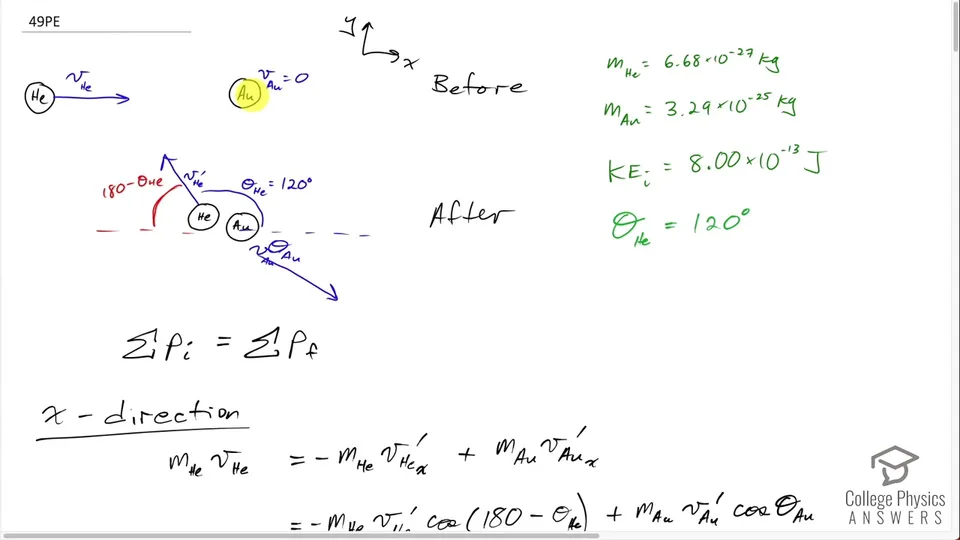 26:10PreviewProblem 49Full video with free trialErnest Rutherford (the first New Zealander to be awarded the Nobel Prize in Chemistry) demonstrated that nuclei were very small and dense by scattering helium-4 nuclei from gold-197 nuclei . The energy of the incoming helium nucleus was , and the masses of the helium and gold nuclei were and , respectively (note that their mass ratio is 4 to 197). (a) If a helium nucleus scatters to an angle of during an elastic collision with a gold nucleus, calculate the helium nucleus’s final speed and the final velocity (magnitude and direction) of the gold nucleus. (b) What is the final kinetic energy of the helium nucleus?
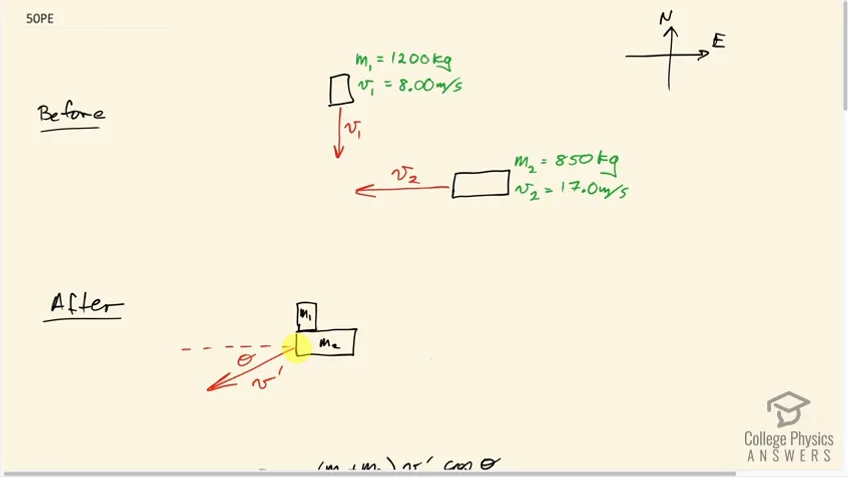 5:08PreviewProblem 50Full video with free trialTwo cars collide at an icy intersection and stick together afterward. The first car has a mass of 1200 kg and is approaching at 8.00 m/s due south. The second car has a mass of 850 kg and is approaching at 17.0 m/s due west. (a) Calculate the final velocity (magnitude and direction) of the cars. (b) How much kinetic energy is lost in the collision? (This energy goes into deformation of the cars.) Note that because both cars have an initial velocity, you cannot use the equations for conservation of momentum along the x -axis and y -axis; instead, you must look for other simplifying aspects.
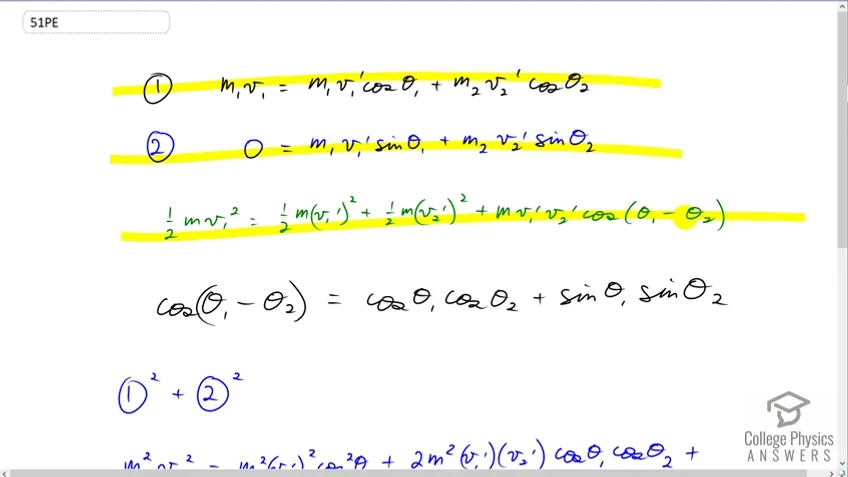 5:07PreviewProblem 51Full video with free trialStarting with equations and for conservation of momentum in the and directions and assuming that one object is originally stationary, prove that for an elastic collision of two objects of equal masses, as discussed in the text.
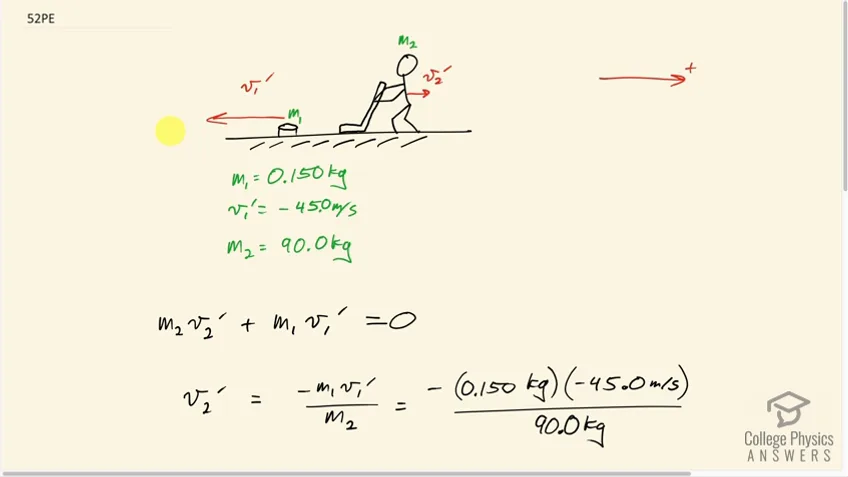 2:27PreviewProblem 52Full video with free trialA 90.0-kg ice hockey player hits a 0.150-kg puck, giving the puck a velocity of 45.0 m/s. If both are initially at rest and if the ice is frictionless, how far does the player recoil in the time it takes the puck to reach the goal 15.0 m away?
8.7 Introduction to Rocket Propulsion
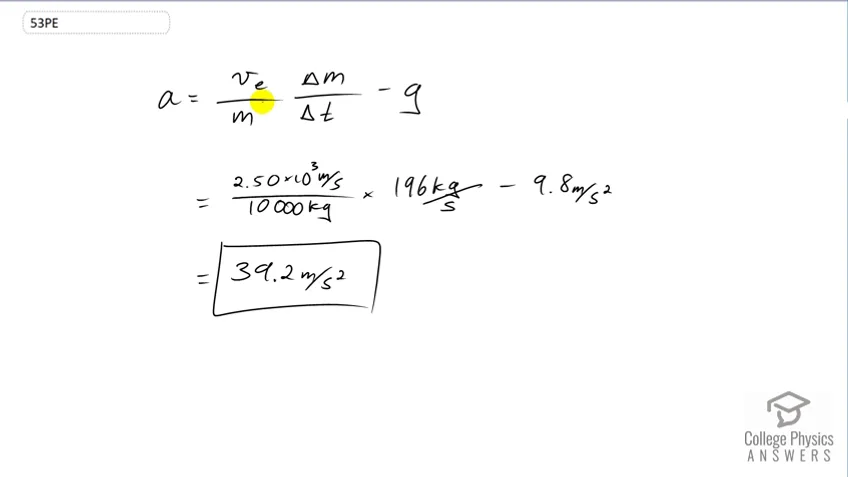 0:59PreviewProblem 53Full video with free trialAntiballistic missiles (ABMs) are designed to have very large accelerations so that they may intercept fast-moving incoming missiles in the short time available. What is the takeoff acceleration of a 10,000-kg ABM that expels 196 kg of gas per second at an exhaust velocity of
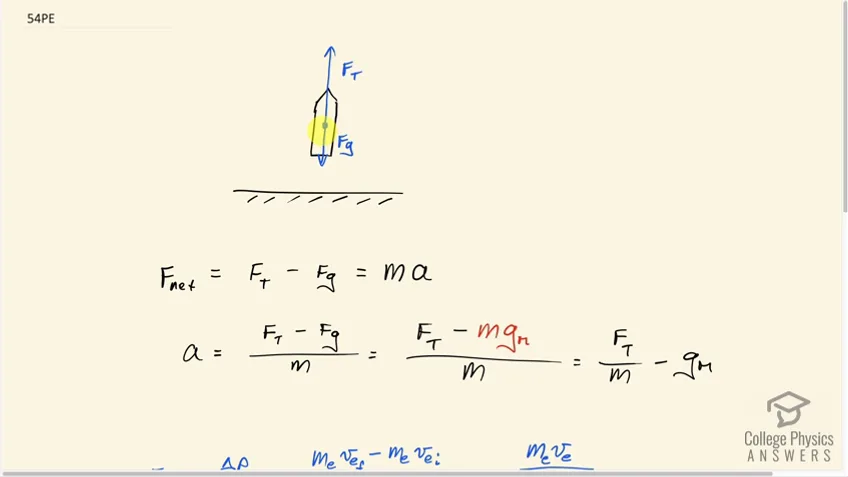 3:27PreviewProblem 54Full video with free trialWhat is the acceleration of a 5000-kg rocket taking off from the Moon, where the acceleration due to gravity is only , if the rocket expels 8.00 kg of gas per second at an exhaust velocity of ?
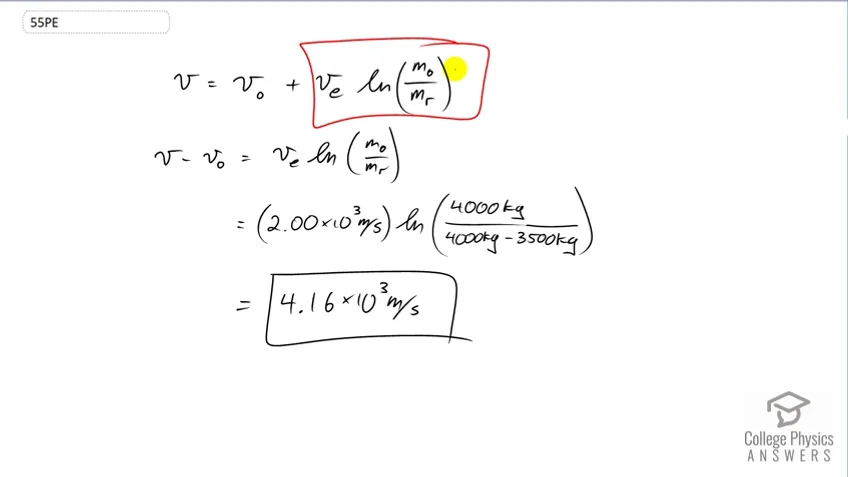 1:06PreviewProblem 55Full video with free trialCalculate the increase in velocity of a 4000-kg space probe that expels 3500 kg of its mass at an exhaust velocity of . You may assume the gravitational force is negligible at the probe’s location.
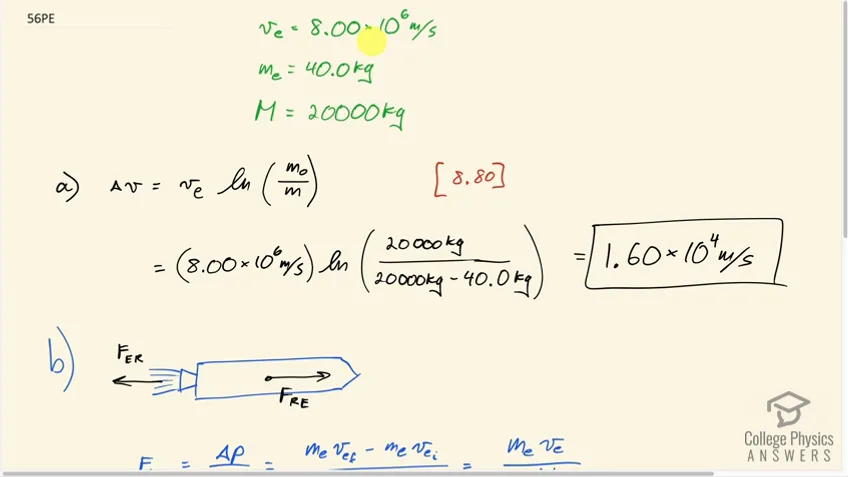 3:57PreviewProblem 56Full video with free trialIon-propulsion rockets have been proposed for use in space. They employ atomic ionization techniques and nuclear energy sources to produce extremely high exhaust velocities, perhaps as great as . These techniques allow a much more favorable payload-to-fuel ratio. To illustrate this fact: (a) Calculate the increase in velocity of a 20,000-kg space probe that expels only 40.0-kg of its mass at the given exhaust velocity. (b) These engines are usually designed to produce a very small thrust for a very long time—the type of engine that might be useful on a trip to the outer planets, for example. Calculate the acceleration of such an engine if it expels at the given velocity, assuming the acceleration due to gravity is negligible.
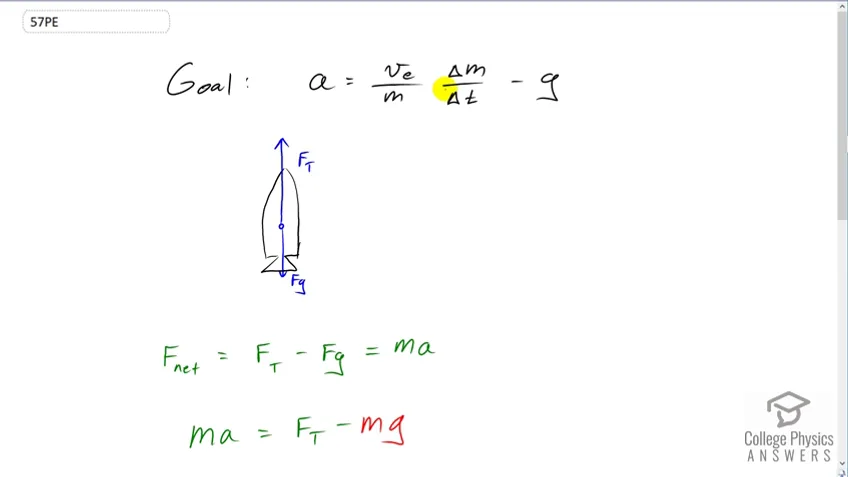 2:19PreviewProblem 57Full video with free trialDerive the equation for the vertical acceleration of a rocket.
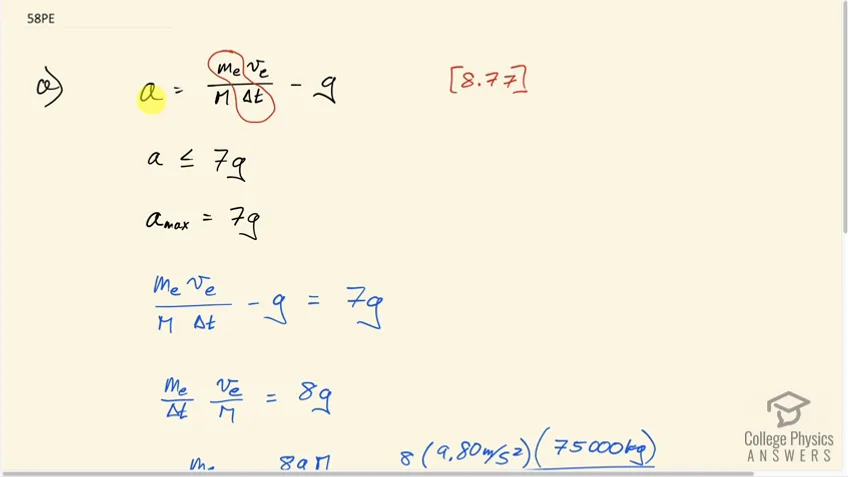 2:02PreviewProblem 58Full video with free trial(a) Calculate the maximum rate at which a rocket can expel gases if its acceleration cannot exceed seven times that of gravity. The mass of the rocket just as it runs out of fuel is 75,000 kg, and its exhaust velocity is . Assume that the acceleration of gravity is the same as on Earth's surface, . (b) Why might it be necessary to limit the acceleration of a rocket?
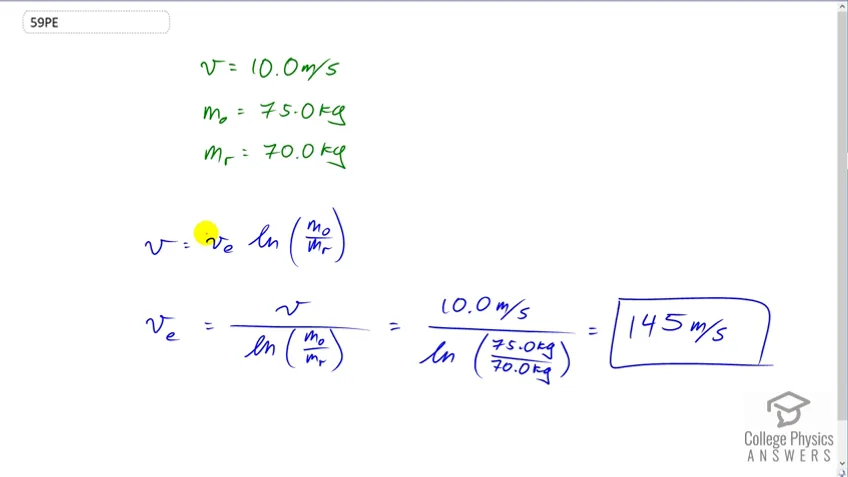 0:59PreviewProblem 59Full video with free trialGiven the following data for a fire extinguisher-toy wagon rocket experiment, calculate the average exhaust velocity of the gases expelled from the extinguisher. Starting from rest, the final velocity is 10.0 m/s. The total mass is initially 75.0 kg and is 70.0 kg after the extinguisher is fired.
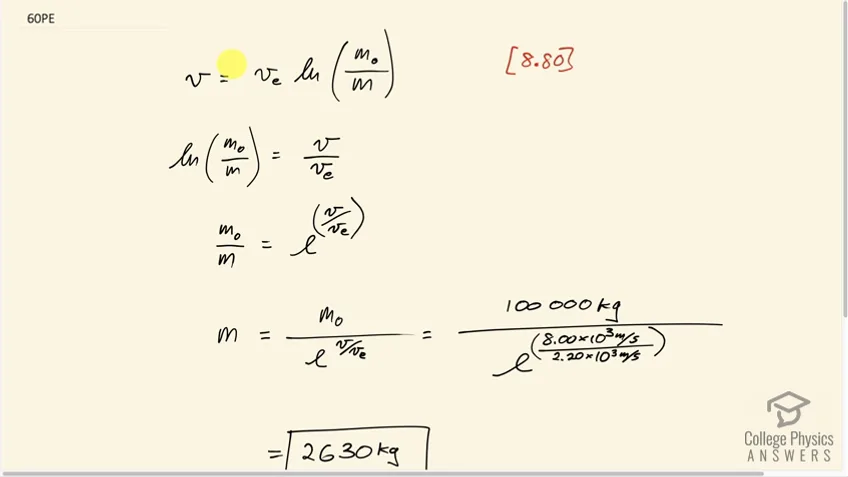 2:00PreviewProblem 60Full video with free trialHow much of a single-stage rocket that is 100,000 kg can be anything but fuel if the rocket is to have a final speed of 8.00 km/s , given that it expels gases at an exhaust velocity of ?
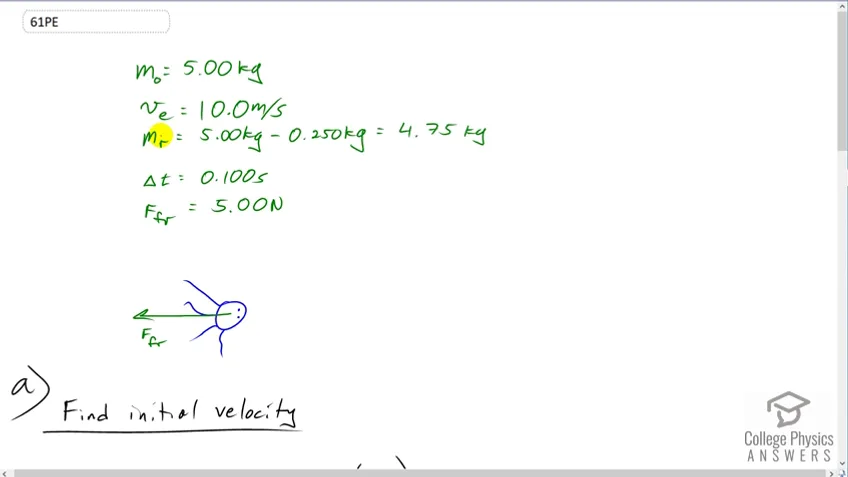 3:53PreviewProblem 61Full video with free trial(a) A 5.00-kg squid initially at rest ejects 0.250-kg of fluid with a velocity of 10.0 m/s. What is the recoil velocity of the squid if the ejection is done in 0.100 s and there is a 5.00-N frictional force opposing the squid’s movement. (b) How much energy is lost to work done against friction?
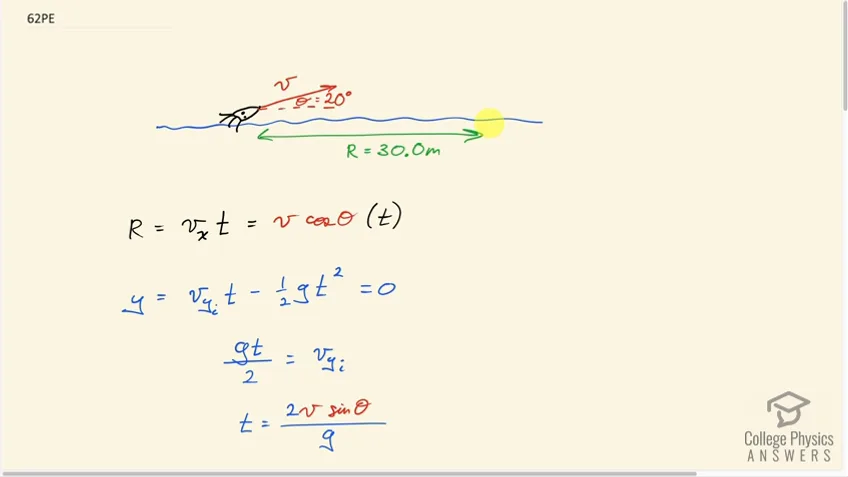 5:09PreviewProblem 62Full video with free trialSquids have been reported to jump from the ocean and travel 30.0 m (measured horizontally) before re-entering the water. (a) Calculate the initial speed of the squid if it leaves the water at an angle of , assuming negligible lift from the air and negligible air resistance. (b) The squid propels itself by squirting water. What fraction of its mass would it have to eject in order to achieve the speed found in the previous part? The water is ejected at 12.0 m/s ; gravitational force and friction are neglected. (c) What is unreasonable about the results? (d) Which premise is unreasonable, or which premises are inconsistent?
Test Prep for AP® Courses
8.1 Linear Momentum and Force
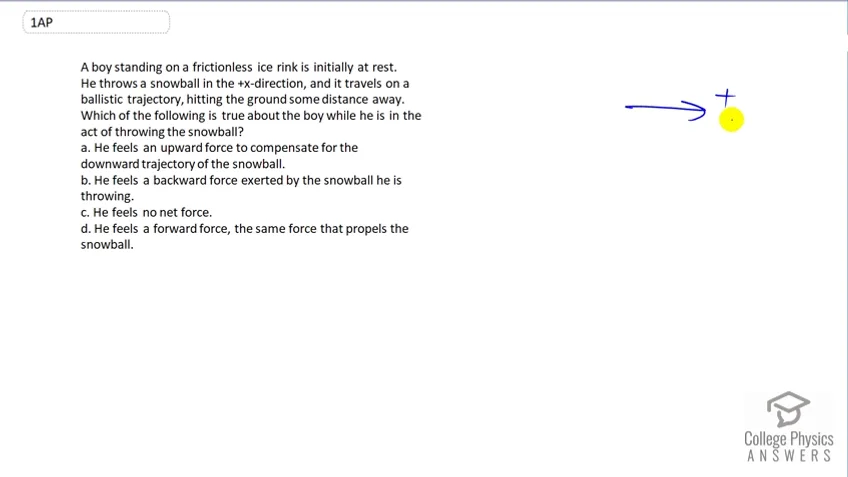 0:30PreviewProblem 1Full video with free trialA boy standing on a frictionless ice rink is initially at rest. He throws a snowball in the +x-direction, and it travels on a ballistic trajectory, hitting the ground some distance away. Which of the following is true about the boy while he is in the act of throwing the snowball? (a) He feels an upward force to compensate for the downward trajectory of the snowball.
(b) He feels a backward force exerted by the snowball he is throwing.
(c) He feels no net force.
(d) He feels a forward force, the same force that propels the snowball.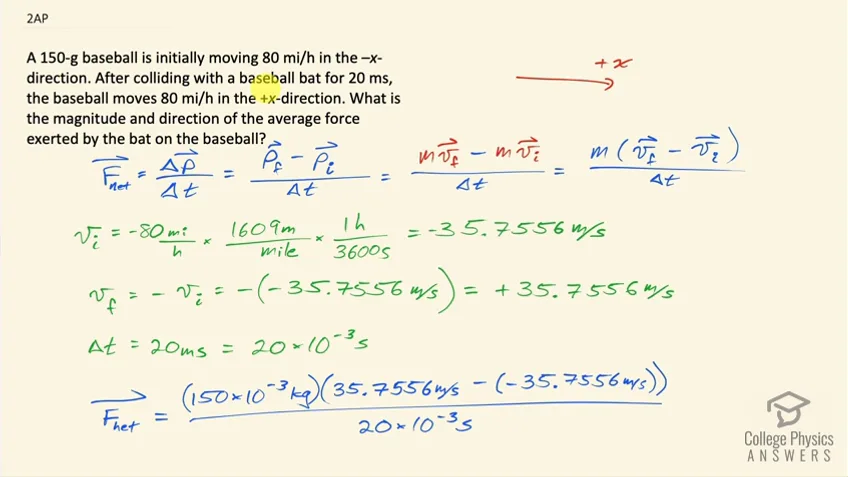 2:13PreviewProblem 2Full video with free trialA 150-g baseball is initially moving 80 mi/h in the –x-direction. After colliding with a baseball bat for 20 ms, the baseball moves 80 mi/h in the +x-direction. What is the magnitude and direction of the average force exerted by the bat on the baseball?
8.2 Impulse
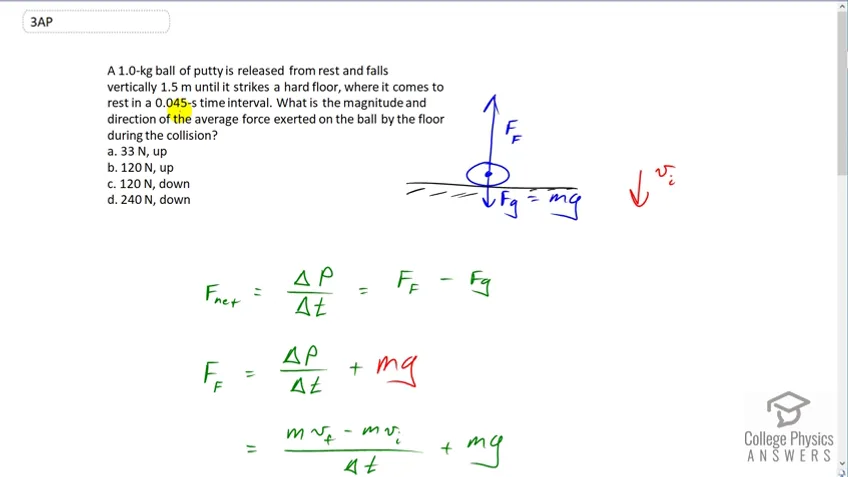 3:27PreviewProblem 3Full video with free trialA 1.0-kg ball of putty is released from rest and falls vertically 1.5 m until it strikes a hard floor, where it comes to rest in a 0.045-s time interval. What is the magnitude and direction of the average force exerted on the ball by the floor during the collision? (a) 33 N, up
(b) 120 N, up
(c) 120 N, down
(d) 240 N, down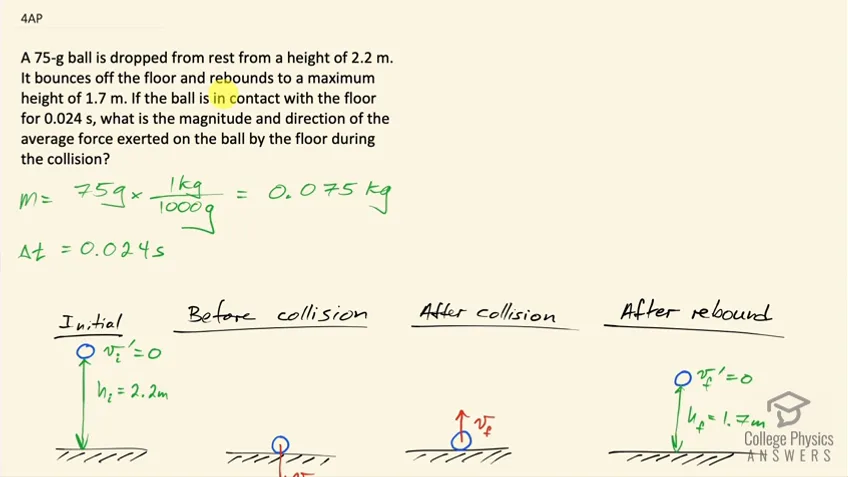 6:47PreviewProblem 4Full video with free trialA 75-g ball is dropped from rest from a height of 2.2 m. It bounces off the floor and rebounds to a maximum height of 1.7 m. If the ball is in contact with the floor for 0.024 s, what is the magnitude and direction of the average force exerted on the ball by the floor during the collision?
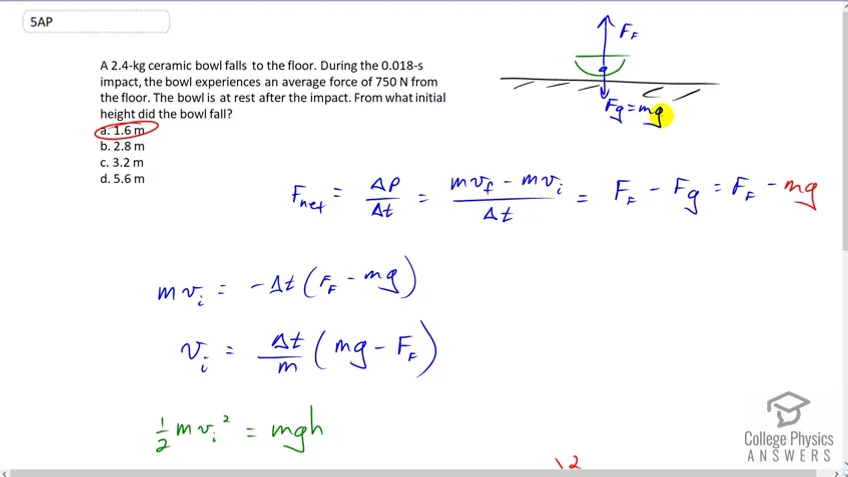 3:26PreviewProblem 5Full video with free trialA 2.4-kg ceramic bowl falls to the floor. During the 0.018-s impact, the bowl experiences an average force of 750 N from the floor. The bowl is at rest after the impact. From what initial height did the bowl fall? (a) 1.6 m
(b) 2.8 m
(c) 3.2 m
(d) 5.6 m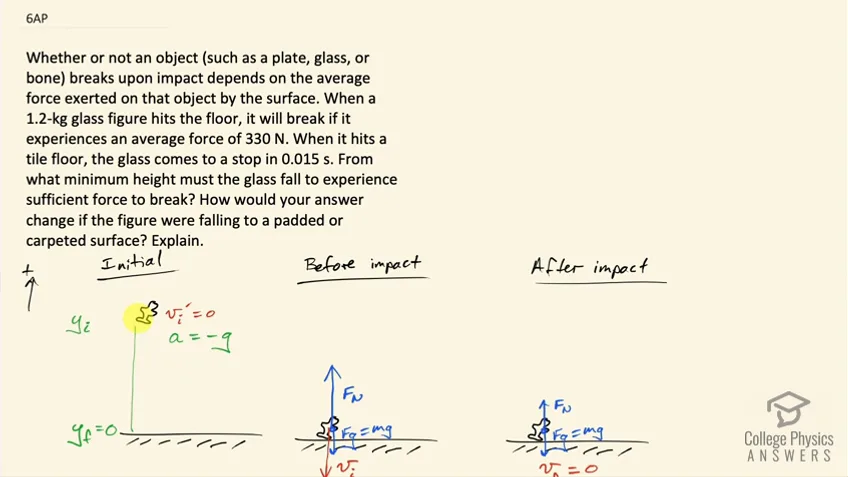 5:59PreviewProblem 6Full video with free trialWhether or not an object (such as a plate, glass, or bone) breaks upon impact depends on the average force exerted on that object by the surface. When a 1.2-kg glass figure hits the floor, it will break if it experiences an average force of 330 N. When it hits a tile floor, the glass comes to a stop in 0.015 s. From what minimum height must the glass fall to experience sufficient force to break? How would your answer change if the figure were falling to a padded or carpeted surface? Explain.
 1:29PreviewProblem 7Full video with free trial
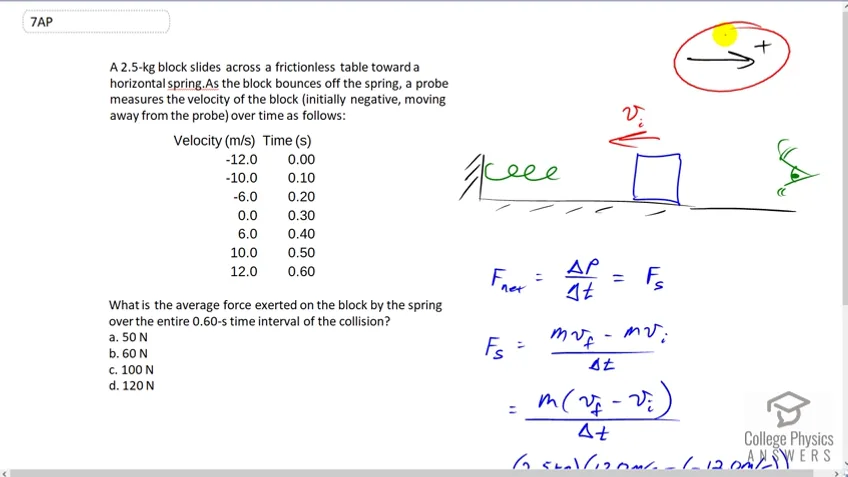
A 2.5-kg block slides across a frictionless table toward a horizontal spring.As the block bounces off the spring, a probe measures the velocity of the block (initially negative, moving away from the probe) over time as follows:
Velocity (m/s) Time (s) -12.0 0 -10.0 0.10 -6.0 0.20 0 0.30 6.0 0.40 10.0 0.50 12.0 0.60 What is the average force exerted on the block by the spring over the entire 0.60-s time interval of the collision? (a) 50 N
(b) 60 N
(c) 100 N
(d) 120 N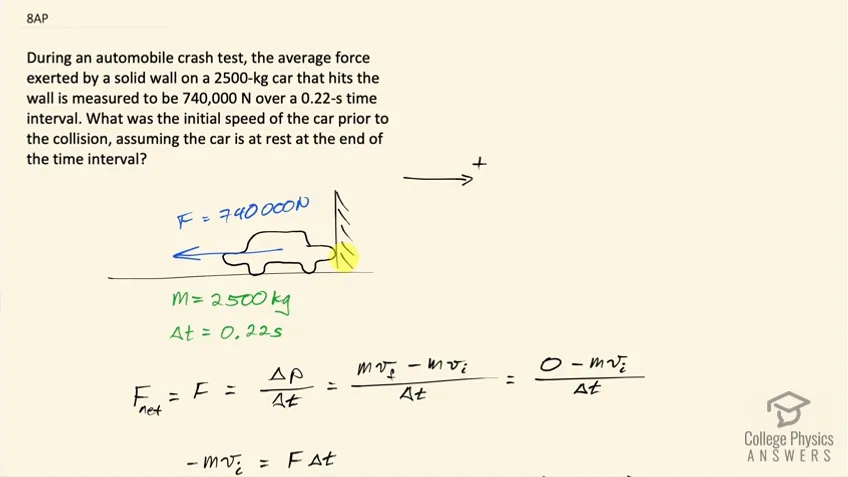 1:30PreviewProblem 8Full video with free trialDuring an automobile crash test, the average force exerted by a solid wall on a 2500-kg car that hits the wall is measured to be 740,000 N over a 0.22-s time interval. What was the initial speed of the car prior to the collision, assuming the car is at rest at the end of the time interval?
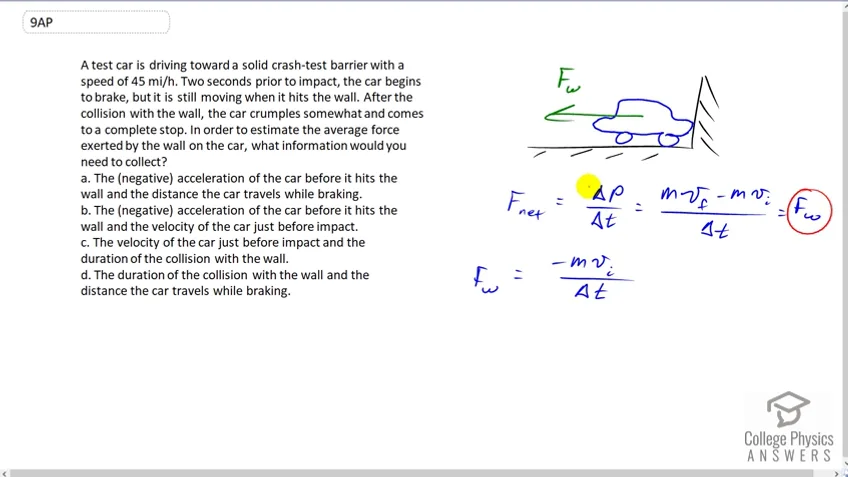 0:36PreviewProblem 9Full video with free trialA test car is driving toward a solid crash-test barrier with a speed of 45 mi/h. Two seconds prior to impact, the car begins to brake, but it is still moving when it hits the wall. After the collision with the wall, the car crumples somewhat and comes to a complete stop. In order to estimate the average force exerted by the wall on the car, what information would you need to collect? (a) The (negative) acceleration of the car before it hits the wall and the distance the car travels while braking.
(b) The (negative) acceleration of the car before it hits the wall and the velocity of the car just before impact.
(c) The velocity of the car just before impact and the duration of the collision with the wall.
(d) The duration of the collision with the wall and the distance the car travels while braking.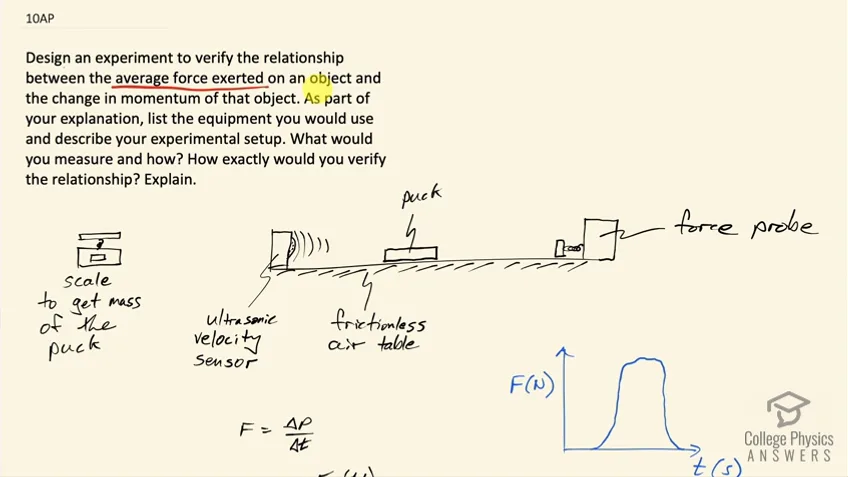 4:15PreviewProblem 10Full video with free trialDesign an experiment to verify the relationship between the average force exerted on an object and the change in momentum of that object. As part of your explanation, list the equipment you would use and describe your experimental setup. What would you measure and how? How exactly would you verify the relationship? Explain.
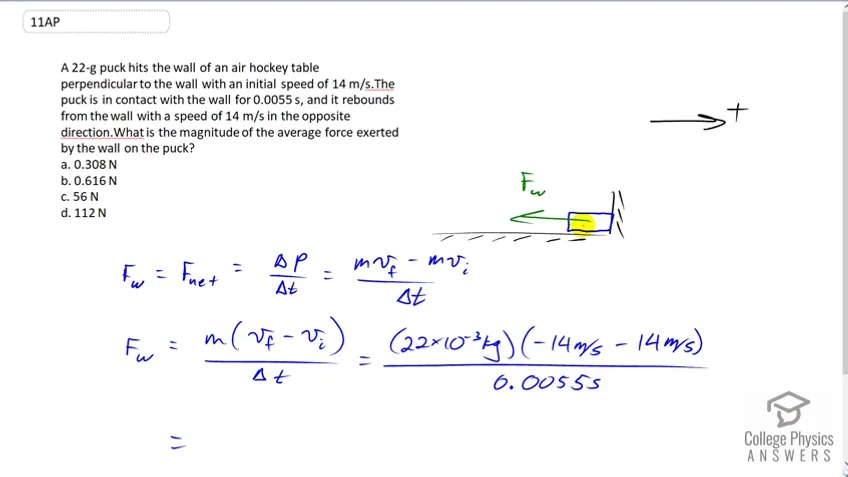 1:08PreviewProblem 11Full video with free trialA 22-g puck hits the wall of an air hockey table perpendicular to the wall with an initial speed of 14 m/s.The puck is in contact with the wall for 0.0055 s, and it rebounds from the wall with a speed of 14 m/s in the opposite direction.What is the magnitude of the average force exerted by the wall on the puck? (a) 0.308 N
(b) 0.616 N
(c) 56 N
(d) 112 N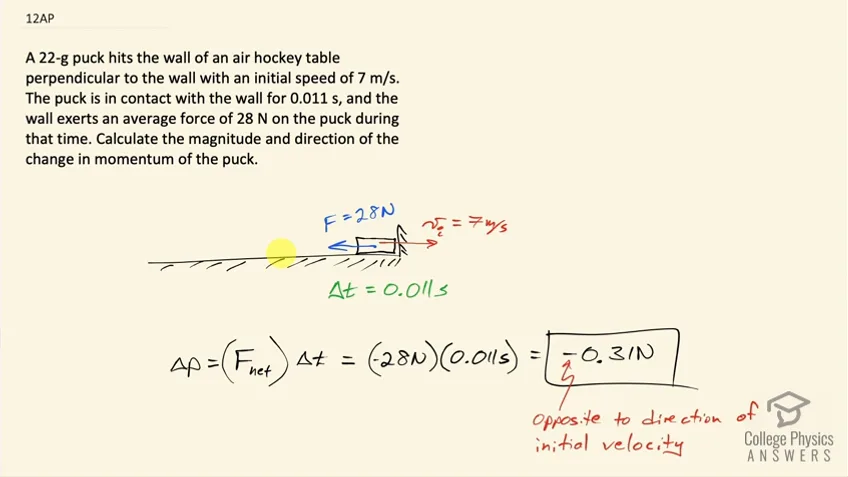 1:38PreviewProblem 12Full video with free trialA 22-g puck hits the wall of an air hockey table perpendicular to the wall with an initial speed of 7 m/s. The puck is in contact with the wall for 0.011 s, and the wall exerts an average force of 28 N on the puck during that time. Calculate the magnitude and direction of the change in momentum of the puck.
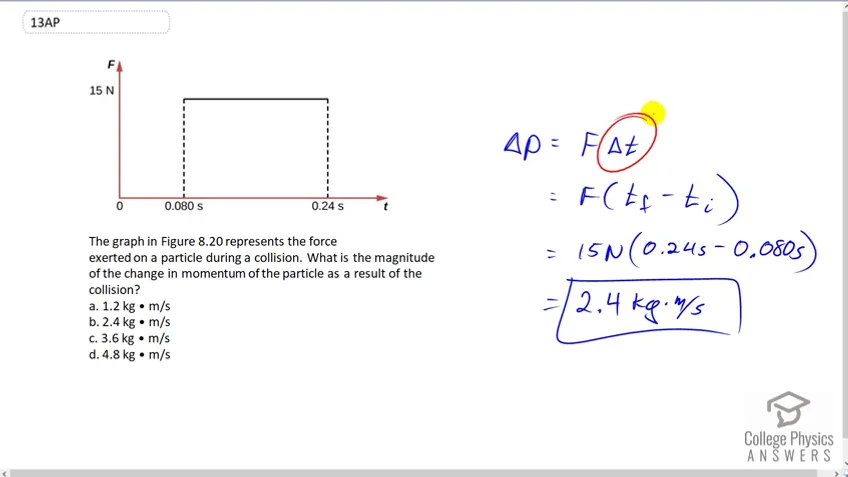 0:42PreviewProblem 13Full video with free trialThe graph in Figure 8.20 represents the force exerted on a particle during a collision. What is the magnitude of the change in momentum of the particle as a result of the collision? (a)
(b)
(c)
(d)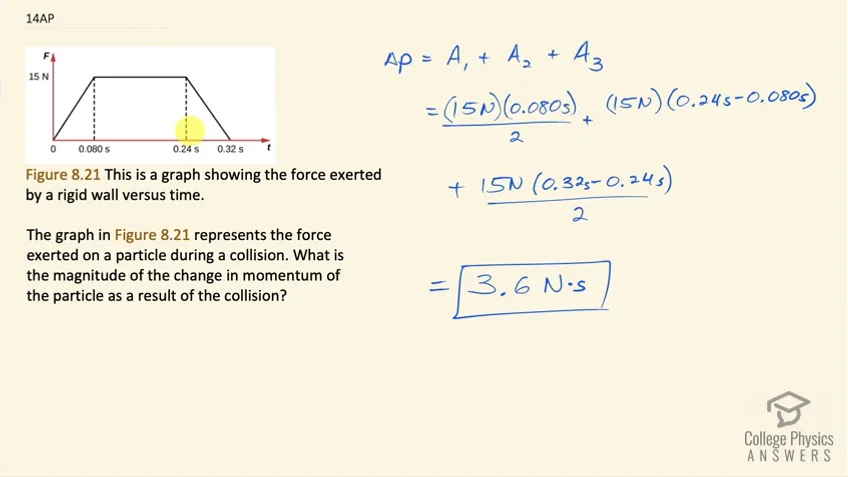 1:38PreviewProblem 14Full video with free trialThe graph in Figure 8.21 represents the force exerted on a particle during a collision. What is the magnitude of the change in momentum of the particle as a result of the collision?
8.3 Conservation of Momentum
 0:42PreviewProblem 15Full video with free trialWhich of the following is an example of an open system? (a) Two air cars colliding on a track elastically.
(b) Two air cars colliding on a track and sticking together.
(c) A bullet being fired into a hanging wooden block and becoming embedded in the block, with the system then acting as a ballistic pendulum.
(d) A bullet being fired into a hillside and becoming buried in the earth.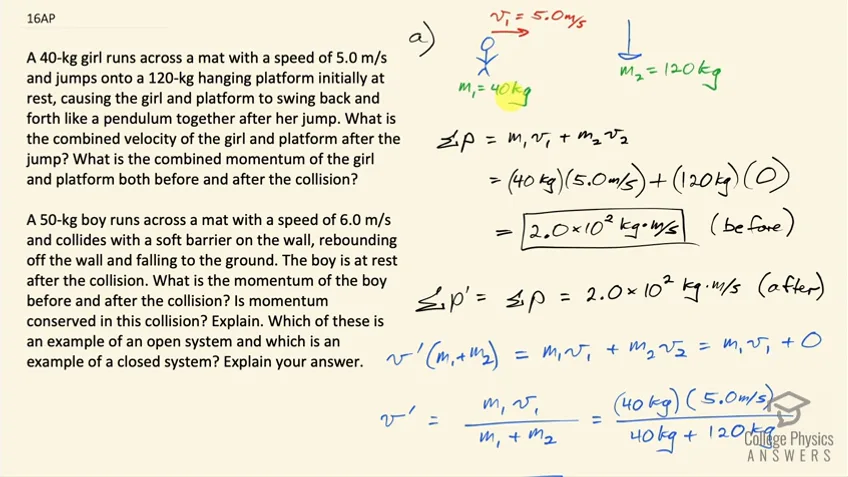 3:36PreviewProblem 16Full video with free trialA 40-kg girl runs across a mat with a speed of 5.0 m/s and jumps onto a 120-kg hanging platform initially at rest, causing the girl and platform to swing back and forth like a pendulum together after her jump. What is the combined velocity of the girl and platform after the jump? What is the combined momentum of the girl and platform both before and after the collision?
 0:29PreviewProblem 17Full video with free trialA student sets up an experiment to measure the momentum of a system of two air cars, A and B, of equal mass, moving on a linear, frictionless track. Before the collision, car A has a certain speed, and car B is at rest. Which of the following will be true about the total momentum of the two cars? (a) It will be greater before the collision.
(b) It will be equal before and after the collision.
(c) It will be greater after the collision.
(d) The answer depends on whether the collision is elastic or inelastic.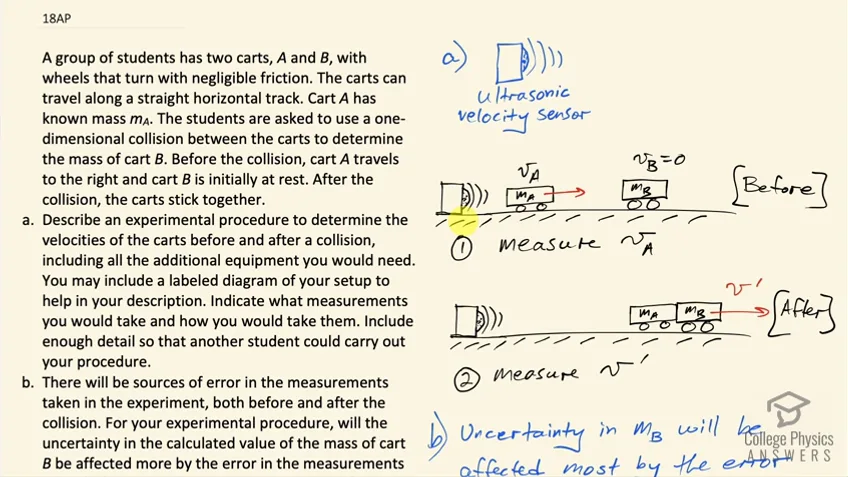 9:35PreviewProblem 18Full video with free trialA group of students has two carts, A and B, with wheels that turn with negligible friction. The carts can travel along a straight horizontal track. Cart A has known mass mA. The students are asked to use a one-dimensional collision between the carts to determine the mass of cart B. Before the collision, cart A travels to the right and cart B is initially at rest. After the collision, the carts stick together. (a) Describe an experimental procedure to determine the velocities of the carts before and after a collision, including all the additional equipment you would need. You may include a labeled diagram of your setup to help in your description. Indicate what measurements you would take and how you would take them. Include enough detail so that another student could carry out your procedure.
(b) There will be sources of error in the measurements taken in the experiment, both before and after the collision. For your experimental procedure, will the uncertainty in the calculated value of the mass of cart B be affected more by the error in the measurements taken before the collision or by those taken after the collision, or will it be equally affected by both sets of measurements? Justify your answer.
(c) A group of students took measurements for one collision. A graph of the students’ data is shown below in Figure 8.22. Given , use the graph to calculate the mass of cart B. Explicitly indicate the principles used in your calculations.
(d) The students are now asked to Consider the kinetic energy changes in an inelastic collision, specifically whether the initial values of one of the physical quantities affect the fraction of mechanical energy dissipated in the collision. How could you modify the experiment to investigate this question? Be sure to explicitly describe the calculations you would make, specifying all equations you would use (but do not actually do any algebra or arithmetic).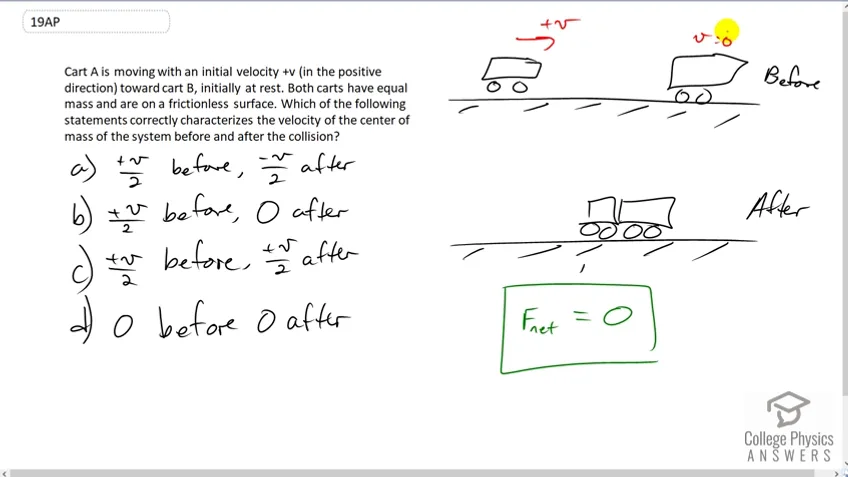 1:12PreviewProblem 19Full video with free trialCart A is moving with an initial velocity +v (in the positive direction) toward cart B, initially at rest. Both carts have equal mass and are on a frictionless surface. Which of the following statements correctly characterizes the velocity of the center of mass of the system before and after the collision? (a) before, , after
(b) before, 0 after
(c) before, after
(d) 0 before, 0 after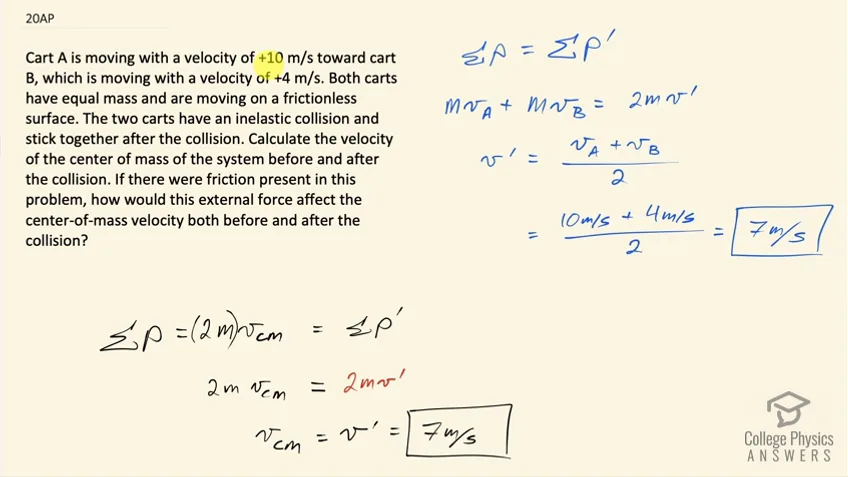 2:52PreviewProblem 20Full video with free trialCart A is moving with a velocity of +10 m/s toward cart B, which is moving with a velocity of +4 m/s. Both carts have equal mass and are moving on a frictionless surface. The two carts have an inelastic collision and stick together after the collision. Calculate the velocity of the center of mass of the system before and after the collision. If there were friction present in this problem, how would this external force affect the center-of-mass velocity both before and after the collision?
8.4 Elastic Collisions in One Dimension
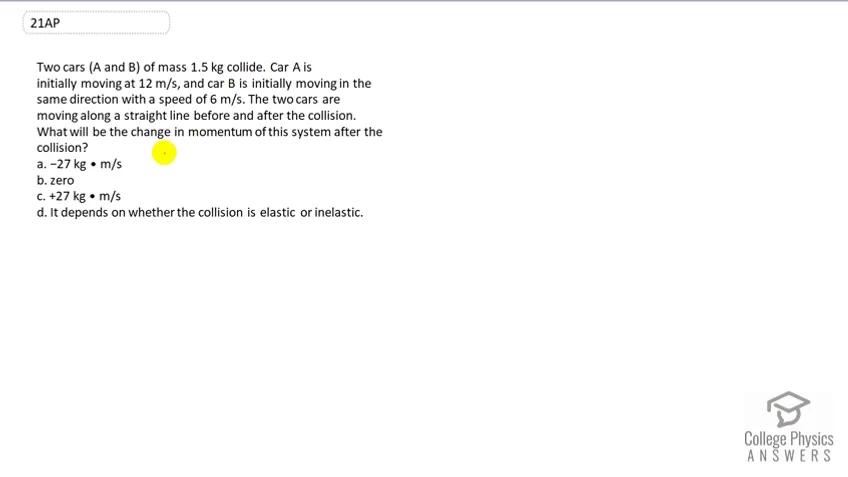 0:58PreviewProblem 21Full video with free trialTwo cars (A and B) of mass 1.5 kg collide. Car A is initially moving at 12 m/s, and car B is initially moving in the same direction with a speed of 6 m/s. The two cars are moving along a straight line before and after the collision. What will be the change in momentum of this system after the collision?
(a)
(b) zero
(c)
(d) It depends on whether the collision is elastic or inelastic.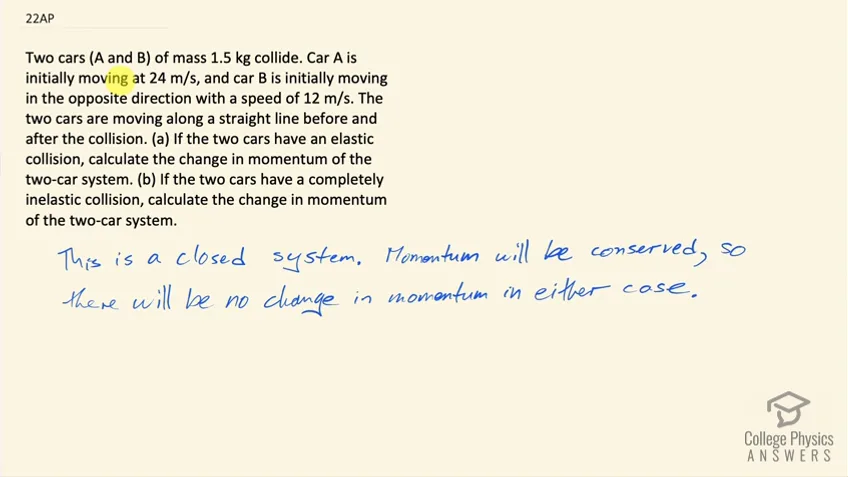 0:42PreviewProblem 22Full video with free trialTwo cars (A and B) of mass 1.5 kg collide. Car A is initially moving at 24 m/s, and car B is initially moving in the opposite direction with a speed of 12 m/s. The two cars are moving along a straight line before and after the collision. (a) If the two cars have an elastic collision, calculate the change in momentum of the two-car system. (b) If the two cars have a completely inelastic collision, calculate the change in momentum of the two-car system.
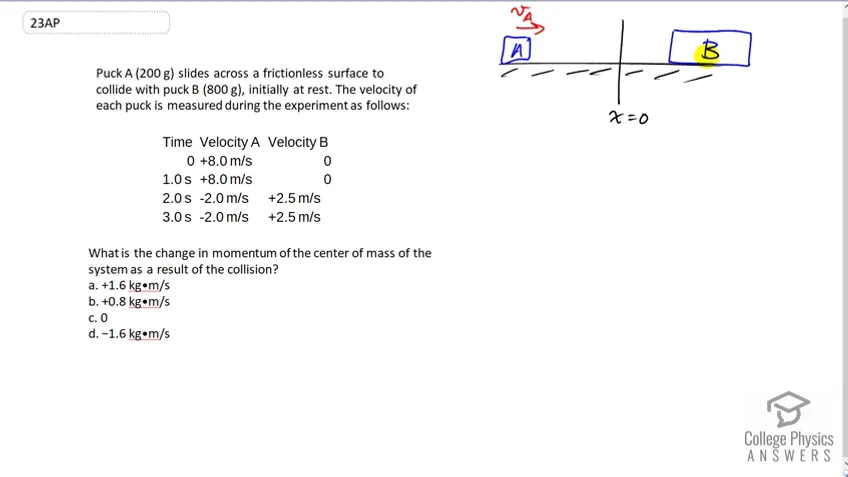 3:38PreviewProblem 23Full video with free trial
Puck A (200 g) slides across a frictionless surface to collide with puck B (800 g), initially at rest. The velocity of each puck is measured during the experiment as follows:
Time Velocity A Velocity B 0 +8.0 m/s 0 1.0 s +8.0 m/s 0 2.0 s -2.0 m/s 0 3.0 s -2.0 m/s +2.5 m/s What is the change in momentum of the center of mass of the system as a result of the collision? (a)
(b)
(c) 0
(d)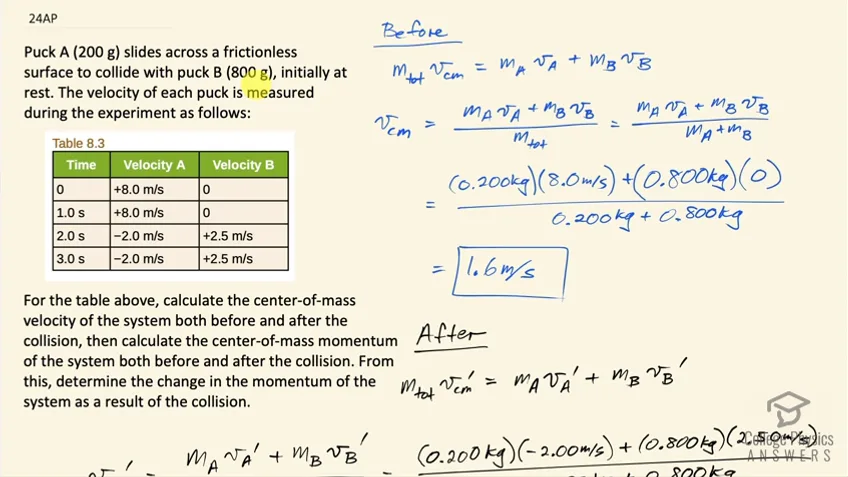 3:56PreviewProblem 24Full video with free trialFor the table 8.3 below, calculate the center-of-mass velocity of the system both before and after the collision, then calculate the center-of-mass momentum of the system both before and after the collision. From this, determine the change in the momentum of the system as a result of the collision.
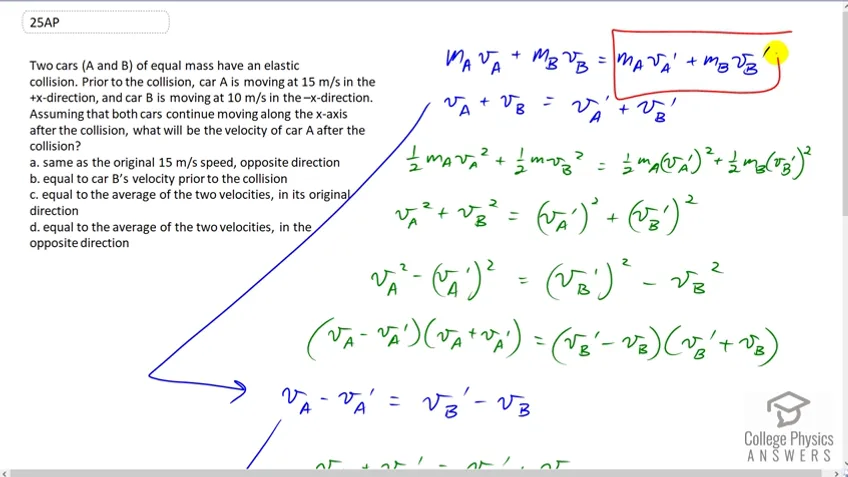 2:27PreviewProblem 25Full video with free trialTwo cars (A and B) of equal mass have an elastic collision. Prior to the collision, car A is moving at 15 m/s in the +x-direction, and car B is moving at 10 m/s in the –x-direction. Assuming that both cars continue moving along the x-axis after the collision, what will be the velocity of car A after the collision? (a) same as the original 15 m/s speed, opposite direction
(b) equal to car B’s velocity prior to the collision
(c) equal to the average of the two velocities, in its original direction
(d) equal to the average of the two velocities, in the opposite direction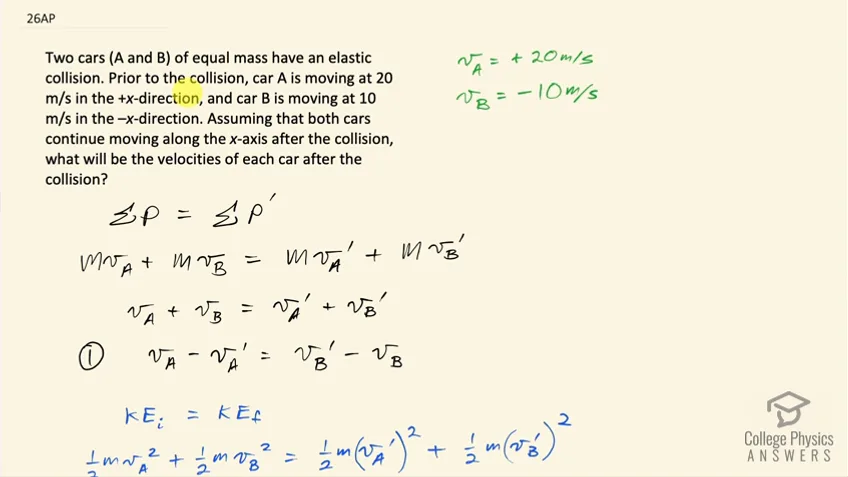 5:45PreviewProblem 26Full video with free trialTwo cars (A and B) of equal mass have an elastic collision. Prior to the collision, car A is moving at 20 m/s in the +x-direction, and car B is moving at 10 m/s in the –x-direction. Assuming that both cars continue moving along the x-axis after the collision, what will be the velocities of each car after the collision?
 1:27PreviewProblem 27Full video with free trialA rubber ball is dropped from rest at a fixed height. It bounces off a hard floor and rebounds upward, but it only reaches 90% of its original fixed height. What is the best way to explain the loss of kinetic energy of the ball during the collision? (a) Energy was required to deform the ball’s shape during the collision with the floor.
(b) Energy was lost due to work done by the ball pushing on the floor during the collision.
(c) Energy was lost due to friction between the ball and the floor.
(d) Energy was lost due to the work done by gravity during the motion.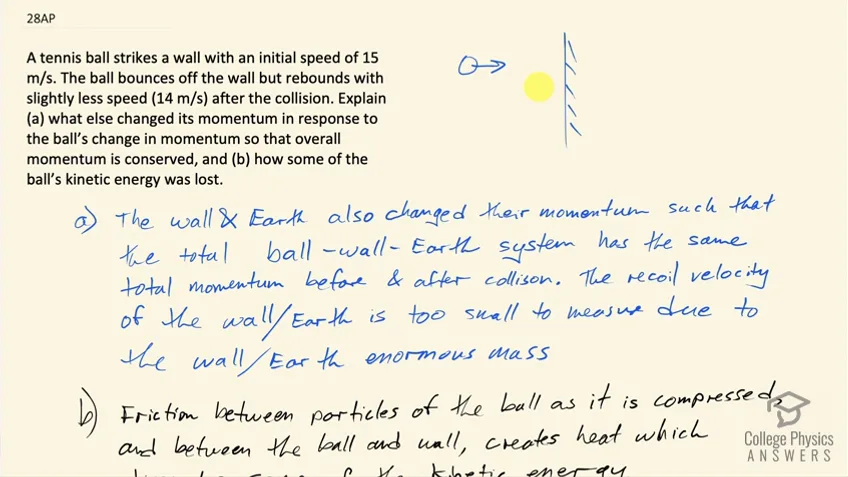 2:27PreviewProblem 28Full video with free trialA tennis ball strikes a wall with an initial speed of 15 m/s. The ball bounces off the wall but rebounds with slightly less speed (14 m/s) after the collision. Explain (a) what else changed its momentum in response to the ball’s change in momentum so that overall momentum is conserved, and (b) how some of the ball’s kinetic energy was lost.
 0:17PreviewProblem 29Full video with free trialTwo objects, A and B, have equal mass. Prior to the collision, mass A is moving 10 m/s in the +x-direction, and mass B is moving 4 m/s in the +x-direction. Which of the following results represents an inelastic collision between A and B? (a) After the collision, mass A is at rest, and mass B moves 14 m/s in the +x-direction.
(b) After the collision, mass A moves 4 m/s in the –x-direction, and mass B moves 18 m/s in the +x-direction.
(c) After the collision, the two masses stick together and move 7 m/s in the +x-direction.
(d) After the collision, mass A moves 4 m/s in the +x-direction, and mass B moves 10 m/s in the +x-direction.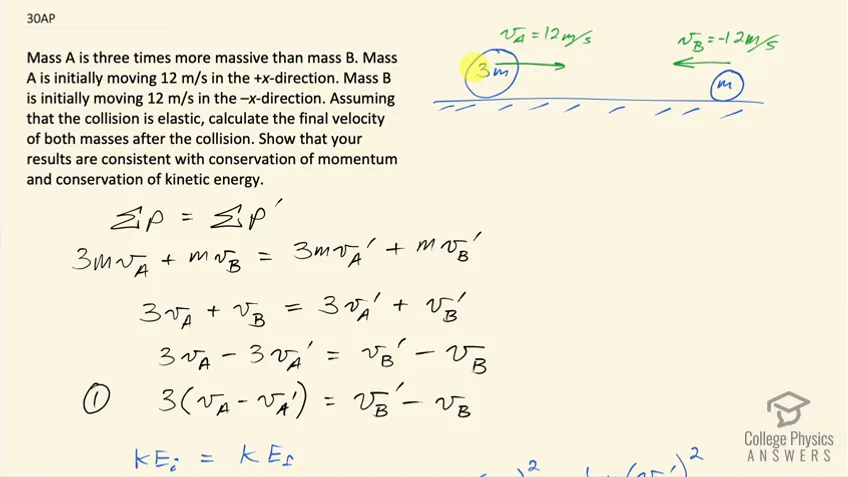 9:48PreviewProblem 30Full video with free trialMass A is three times more massive than mass B. Mass A is initially moving 12 m/s in the +x-direction. Mass B is initially moving 12 m/s in the –x-direction. Assuming that the collision is elastic, calculate the final velocity of both masses after the collision. Show that your results are consistent with conservation of momentum and conservation of kinetic energy.
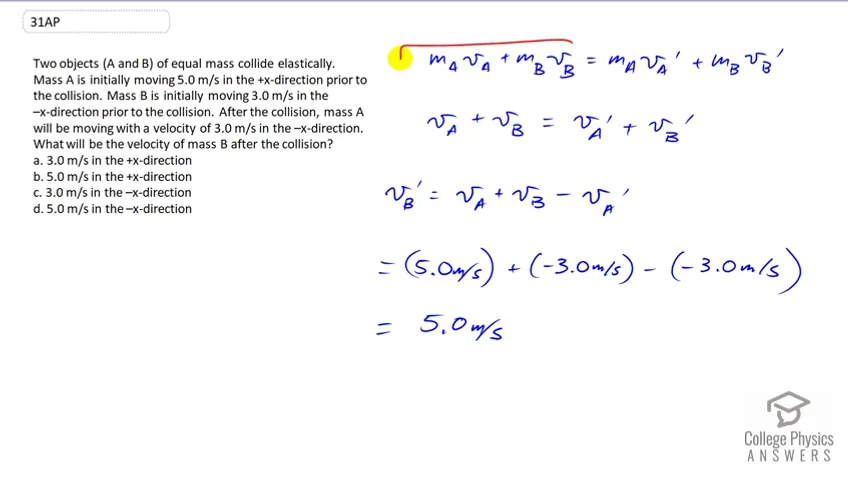 1:41PreviewProblem 31Full video with free trialTwo objects (A and B) of equal mass collide elastically. Mass A is initially moving 5.0 m/s in the +x-direction prior to the collision. Mass B is initially moving 3.0 m/s in the –x-direction prior to the collision. After the collision, mass A will be moving with a velocity of 3.0 m/s in the –x-direction. What will be the velocity of mass B after the collision? (a) 3.0 m/s in the +x-direction
(b) 5.0 m/s in the +x-direction
(c) 3.0 m/s in the –x-direction
(d) 5.0 m/s in the –x-direction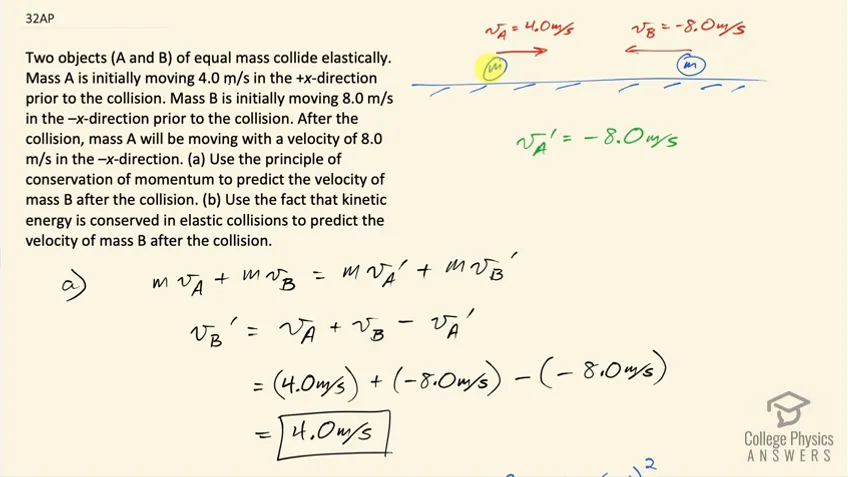 4:07PreviewProblem 32Full video with free trialTwo objects (A and B) of equal mass collide elastically. Mass A is initially moving 4.0 m/s in the +x-direction prior to the collision. Mass B is initially moving 8.0 m/s in the –x-direction prior to the collision. After the collision, mass A will be moving with a velocity of 8.0 m/s in the –x-direction. (a) Use the principle of conservation of momentum to predict the velocity of mass B after the collision. (b) Use the fact that kinetic energy is conserved in elastic collisions to predict the velocity of mass B after the collision.
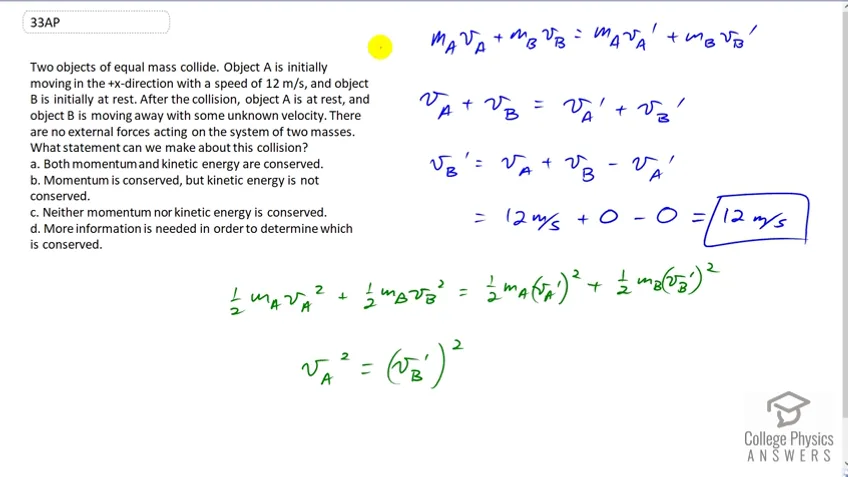 2:16PreviewProblem 33Full video with free trialTwo objects of equal mass collide. Object A is initially moving in the +x-direction with a speed of 12 m/s, and object B is initially at rest. After the collision, object A is at rest, and object B is moving away with some unknown velocity. There are no external forces acting on the system of two masses. What statement can we make about this collision? (a) Both momentum and kinetic energy are conserved.
(b) Momentum is conserved, but kinetic energy is not conserved.
(c) Neither momentum nor kinetic energy is conserved.
(d) More information is needed in order to determine which is conserved.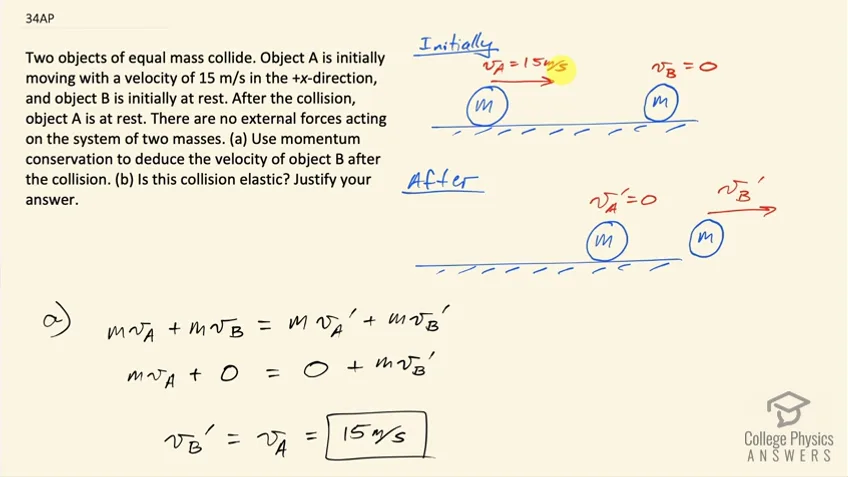 2:19PreviewProblem 34Full video with free trialTwo objects of equal mass collide. Object A is initially moving with a velocity of 15 m/s in the +x-direction, and object B is initially at rest. After the collision, object A is at rest. There are no external forces acting on the system of two masses. (a) Use momentum conservation to deduce the velocity of object B after the collision. (b) Is this collision elastic? Justify your answer.
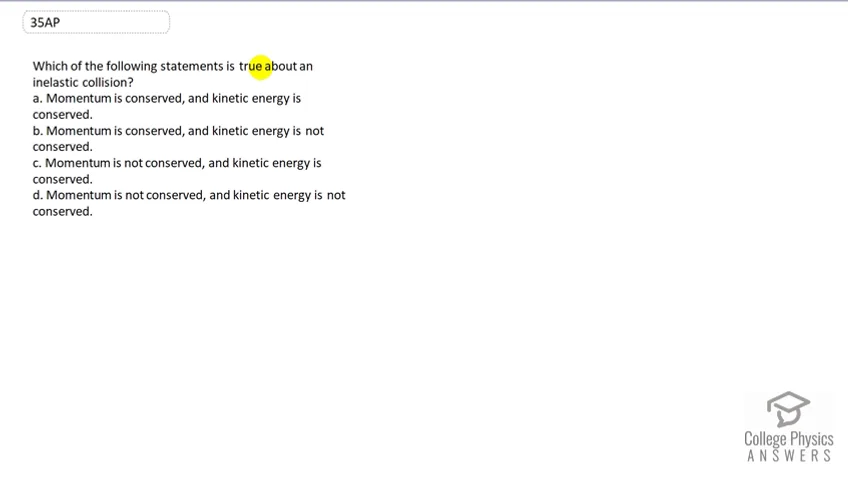 0:28PreviewProblem 35Full video with free trialWhich of the following statements is true about an inelastic collision? (a) Momentum is conserved, and kinetic energy is conserved.
(b) Momentum is conserved, and kinetic energy is not conserved.
(c) Momentum is not conserved, and kinetic energy is conserved.
(d) Momentum is not conserved, and kinetic energy is not conserved.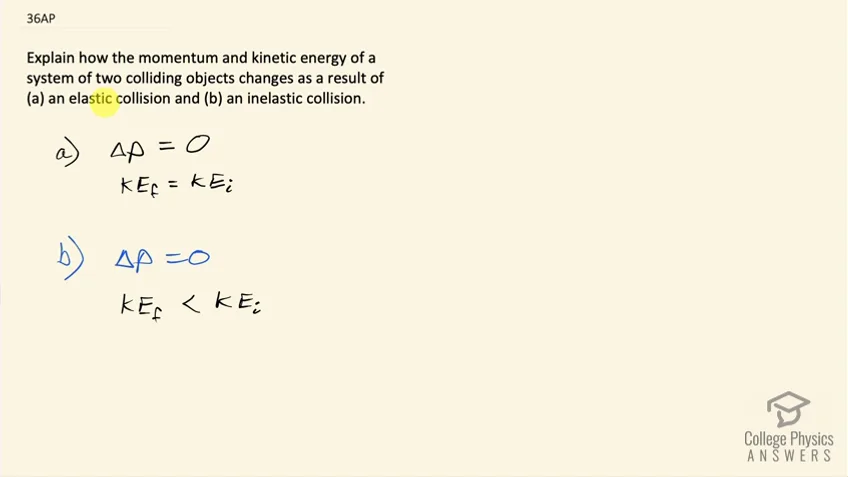 1:10PreviewProblem 36Full video with free trialExplain how the momentum and kinetic energy of a system of two colliding objects changes as a result of (a) an elastic collision and (b) an inelastic collision.
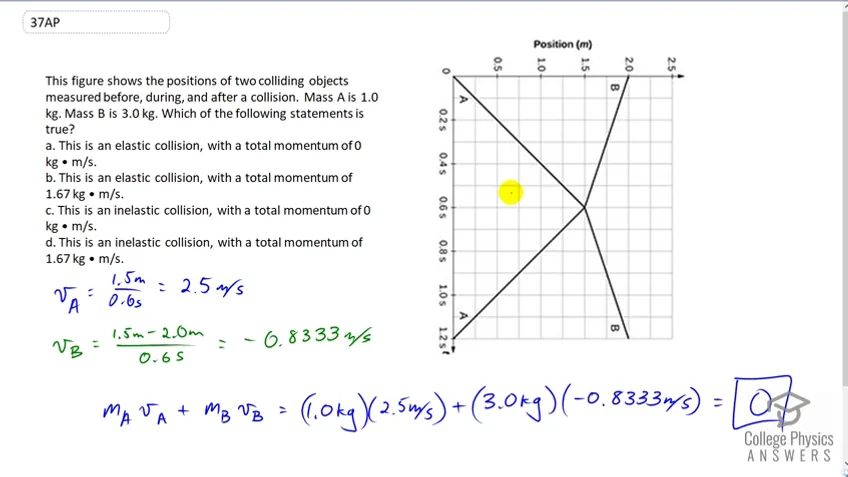 3:50PreviewProblem 37Full video with free trialFigure 8.33 below shows the positions of two colliding objects measured before, during, and after a collision. Mass A is 1.0 kg. Mass B is 3.0 kg. Which of the following statements is true? (a) This is an elastic collision, with a total momentum of 0 kg • m/s.
(b) This is an elastic collision, with a total momentum of 1.67 kg • m/s.
(c) This is an inelastic collision, with a total momentum of 0 kg • m/s.
(d) This is an inelastic collision, with a total momentum of 1.67 kg • m/s.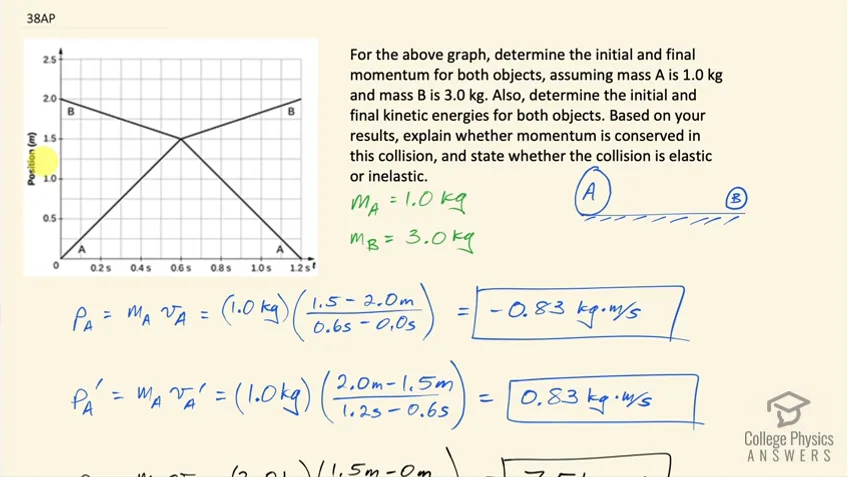 5:53PreviewProblem 38Full video with free trialFor the below graph, determine the initial and final momentum for both objects, assuming mass A is 1.0 kg and mass B is 3.0 kg. Also, determine the initial and final kinetic energies for both objects. Based on your results, explain whether momentum is conserved in this collision, and state whether the collision is elastic or inelastic.
 0:27PreviewProblem 39Full video with free trialMass A (1.0 kg) slides across a frictionless surface with a velocity of 8 m/s in the positive direction. Mass B (3.0 kg) is initially at rest. The two objects collide and stick together. What will be the change in the center-of-mass velocity of the system as a result of the collision? (a) There will be no change in the center-of-mass velocity.
(b) The center-of-mass velocity will decrease by 2 m/s.
(c) The center-of-mass velocity will decrease by 6 m/s.
(d) The center-of-mass velocity will decrease by 8 m/s.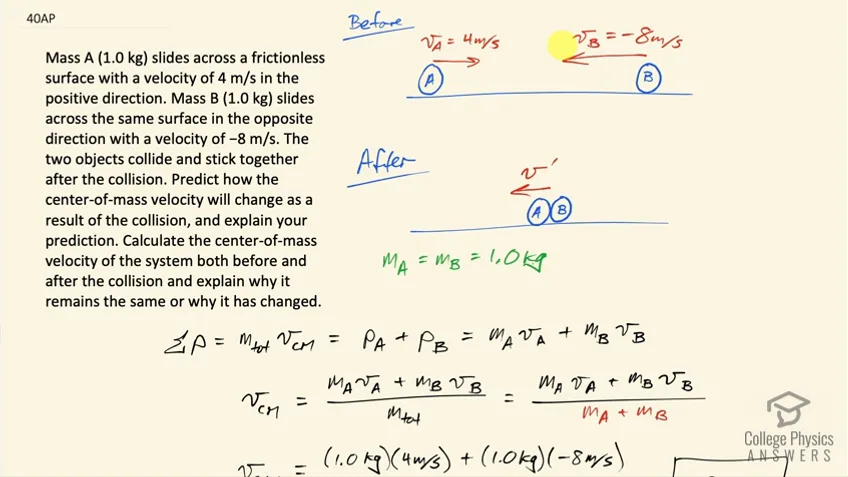 2:57PreviewProblem 40Full video with free trialMass A (1.0 kg) slides across a frictionless surface with a velocity of 4 m/s in the positive direction. Mass B (1.0 kg) slides across the same surface in the opposite direction with a velocity of −8 m/s. The two objects collide and stick together after the collision. Predict how the center-of-mass velocity will change as a result of the collision, and explain your prediction. Calculate the center-of-mass velocity of the system both before and after the collision and explain why it remains the same or why it has changed.
8.5 Inelastic Collisions in One Dimension
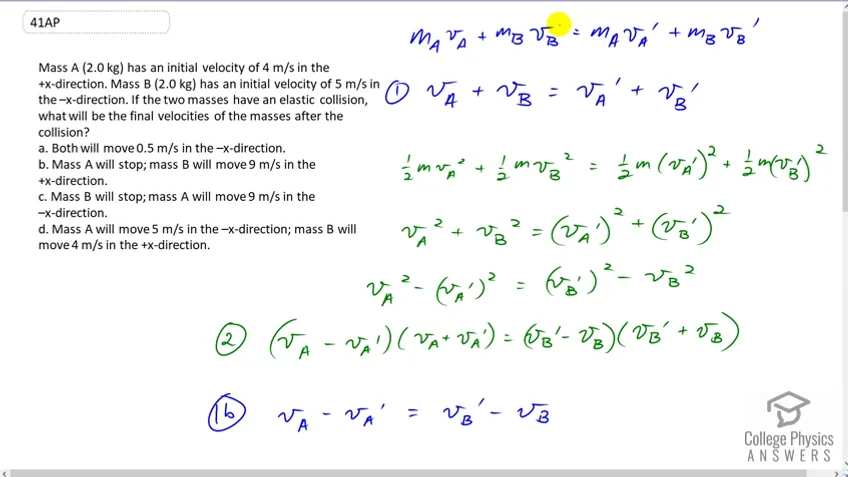 3:31PreviewProblem 41Full video with free trialMass A (2.0 kg) has an initial velocity of 4 m/s in the +x-direction. Mass B (2.0 kg) has an initial velocity of 5 m/s in the –x-direction. If the two masses have an elastic collision, what will be the final velocities of the masses after the collision? (a) Both will move 0.5 m/s in the –x-direction.
(b) Mass A will stop; mass B will move 9 m/s in the +x-direction.
(c) Mass B will stop; mass A will move 9 m/s in the –x-direction.
(d) Mass A will move 5 m/s in the –x-direction; mass B will move 4 m/s in the +x-direction.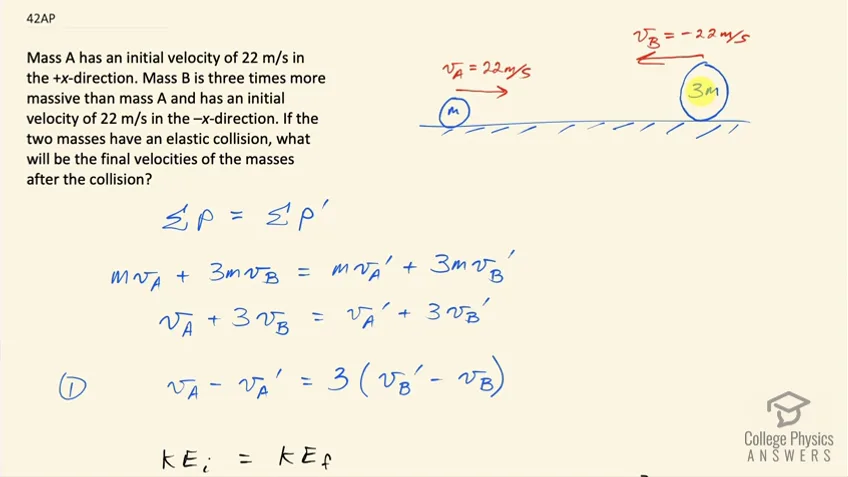 6:28PreviewProblem 42Full video with free trialMass A has an initial velocity of 22 m/s in the +x-direction. Mass B is three times more massive than mass A and has an initial velocity of 22 m/s in the –x-direction. If the two masses have an elastic collision, what will be the final velocities of the masses after the collision?
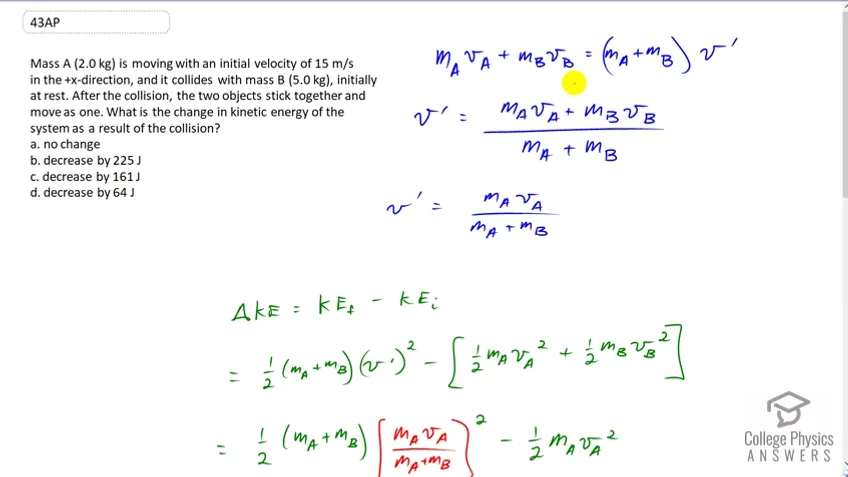 4:25PreviewProblem 43Full video with free trialMass A (2.0 kg) is moving with an initial velocity of 15 m/s in the +x-direction, and it collides with mass B (5.0 kg), initially at rest. After the collision, the two objects stick together and move as one. What is the change in kinetic energy of the system as a result of the collision? (a) no change
(b) decrease by 225 J
(c) decrease by 161 J
(d) decrease by 64 J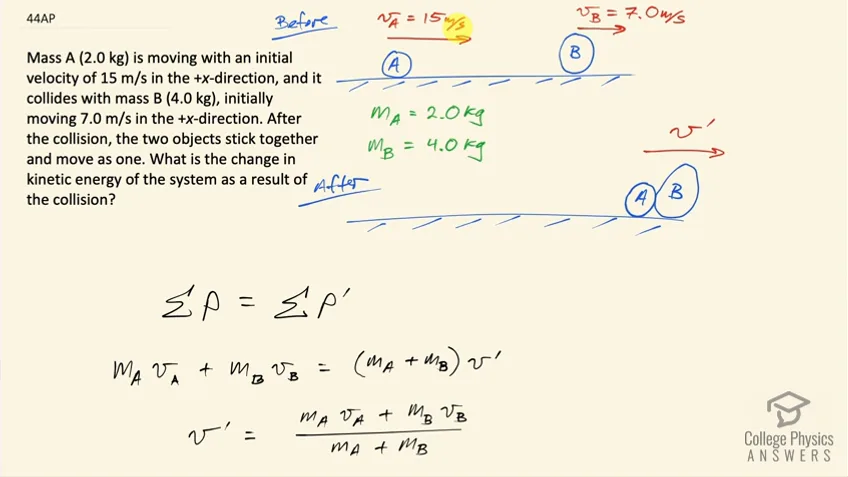 2:11PreviewProblem 44Full video with free trialMass A (2.0 kg) is moving with an initial velocity of 15 m/s in the +x-direction, and it collides with mass B (4.0 kg), initially moving 7.0 m/s in the +x-direction. After the collision, the two objects stick together and move as one. What is the change in kinetic energy of the system as a result of the collision?
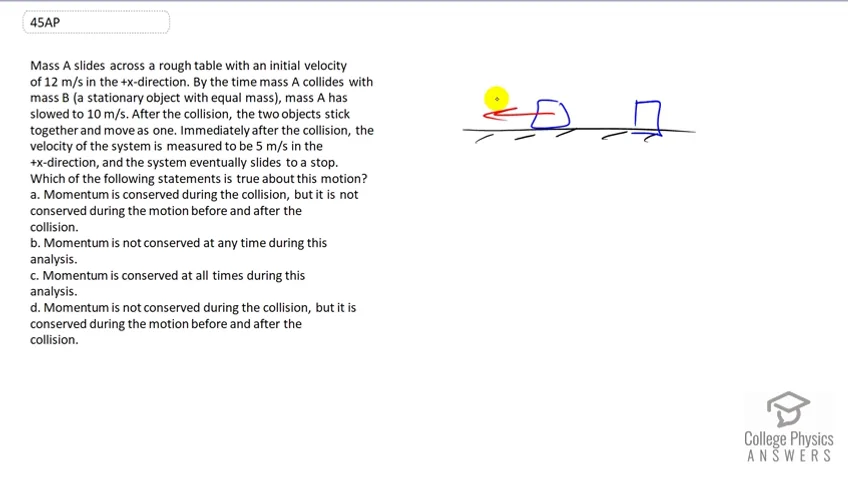 1:50PreviewProblem 45Full video with free trialMass A slides across a rough table with an initial velocity of 12 m/s in the +x-direction. By the time mass A collides with mass B (a stationary object with equal mass), mass A has slowed to 10 m/s. After the collision, the two objects stick together and move as one. Immediately after the collision, the velocity of the system is measured to be 5 m/s in the +x-direction, and the system eventually slides to a stop. Which of the following statements is true about this motion? (a) Momentum is conserved during the collision, but it is not conserved during the motion before and after the collision.
(b) Momentum is not conserved at any time during this analysis.
(c) Momentum is conserved at all times during this analysis.
(d) Momentum is not conserved during the collision, but it is conserved during the motion before and after the collision.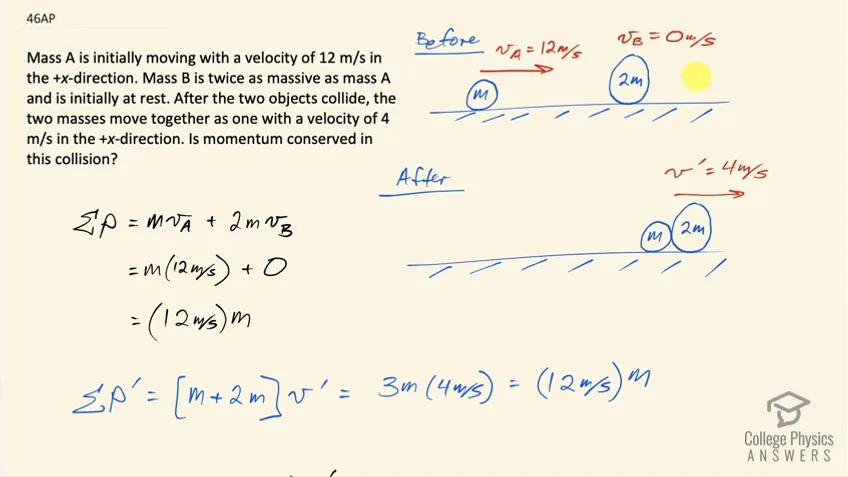 1:27PreviewProblem 46Full video with free trialMass A is initially moving with a velocity of 12 m/s in the +x-direction. Mass B is twice as massive as mass A and is initially at rest. After the two objects collide, the two masses move together as one with a velocity of 4 m/s in the +x-direction. Is momentum conserved in this collision?
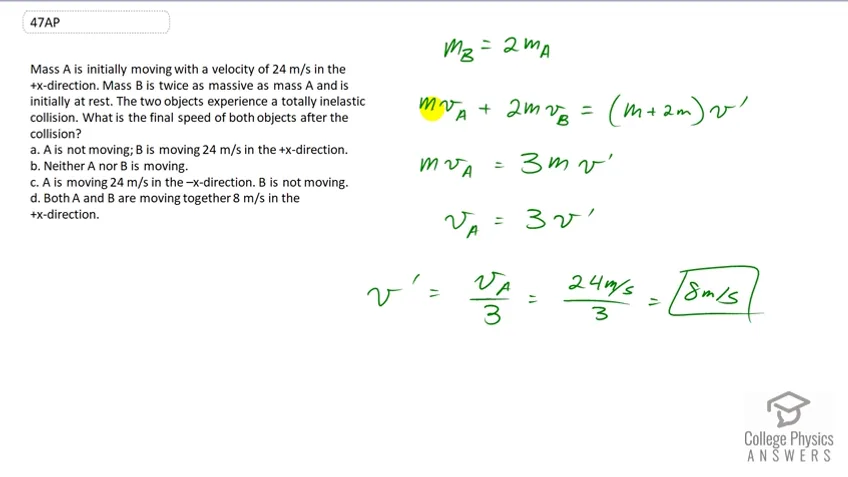 1:25PreviewProblem 47Full video with free trialMass A is initially moving with a velocity of 24 m/s in the +x-direction. Mass B is twice as massive as mass A and is initially at rest. The two objects experience a totally inelastic collision. What is the final speed of both objects after the collision? (a) A is not moving; B is moving 24 m/s in the +x-direction.
(b) Neither A nor B is moving.
(c) A is moving 24 m/s in the –x-direction. B is not moving.
(d) Both A and B are moving together 8 m/s in the +x-direction.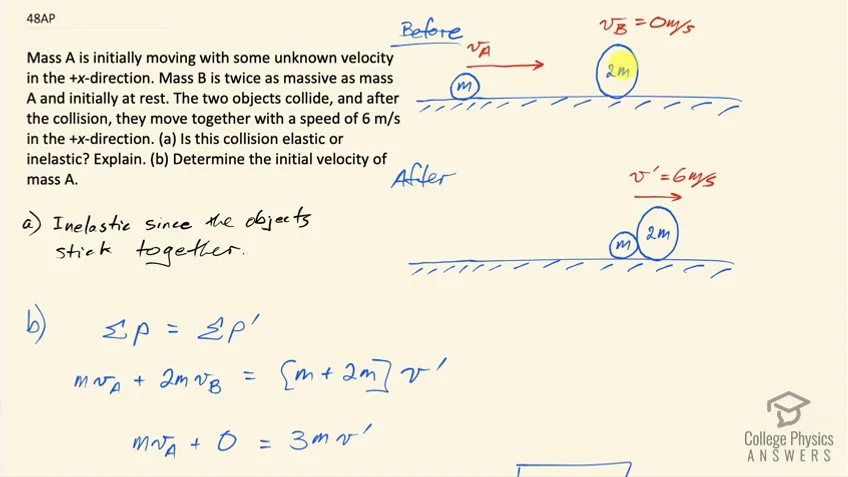 1:22PreviewProblem 48Full video with free trialMass A is initially moving with some unknown velocity in the +x-direction. Mass B is twice as massive as mass A and initially at rest. The two objects collide, and after the collision, they move together with a speed of 6 m/s in the +x-direction. (a) Is this collision elastic or inelastic? Explain. (b) Determine the initial velocity of mass A.
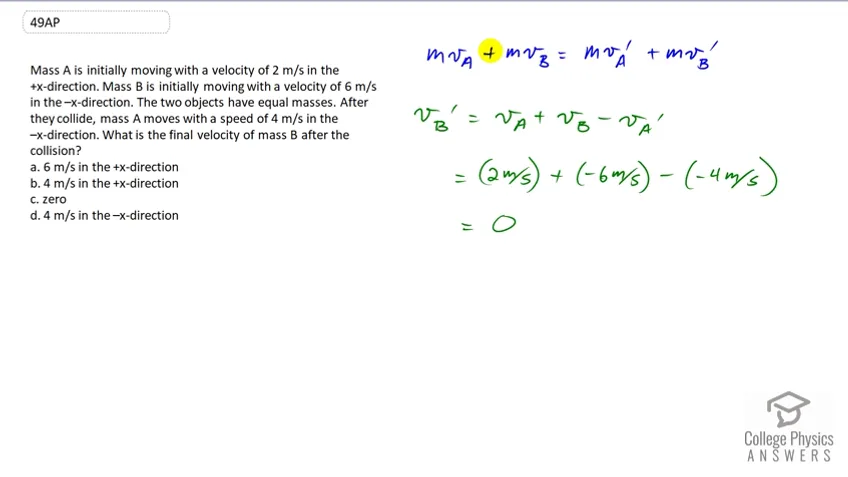 1:16PreviewProblem 49Full video with free trialMass A is initially moving with a velocity of 2 m/s in the +x-direction. Mass B is initially moving with a velocity of 6 m/s in the –x-direction. The two objects have equal masses. After they collide, mass A moves with a speed of 4 m/s in the –x-direction. What is the final velocity of mass B after the collision? (a) 6 m/s in the +x-direction
(b) 4 m/s in the +x-direction
(c) zero
(d) 4 m/s in the –x-direction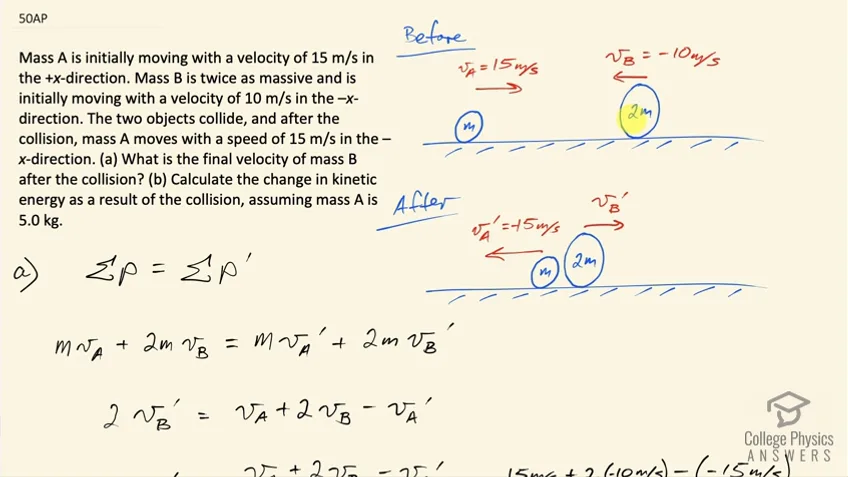 2:47PreviewProblem 50Full video with free trialMass A is initially moving with a velocity of 15 m/s in the +x-direction. Mass B is twice as massive and is initially moving with a velocity of 10 m/s in the –x-direction. The two objects collide, and after the collision, mass A moves with a speed of 15 m/s in the –x-direction. (a) What is the final velocity of mass B after the collision? (b) Calculate the change in kinetic energy as a result of the collision, assuming mass A is 5.0 kg.
8.6 Collisions of Point Masses in Two Dimensions
 0:28PreviewProblem 51Full video with free trialTwo cars of equal mass approach an intersection. Car A is moving east at a speed of 45 m/s. Car B is moving south at a speed of 35 m/s. They collide inelastically and stick together after the collision, moving as one object. Which of the following statements is true about the center-of-mass velocity of this system? (a) The center-of-mass velocity will decrease after the collision as a result of lost energy (but not drop to zero).
(b) The center-of-mass velocity will remain the same after the collision since momentum is conserve
(c) The center-of-mass velocity will drop to zero since the two objects stick together.
(d) The magnitude of the center-of-mass velocity will remain the same, but the direction of the velocity will change.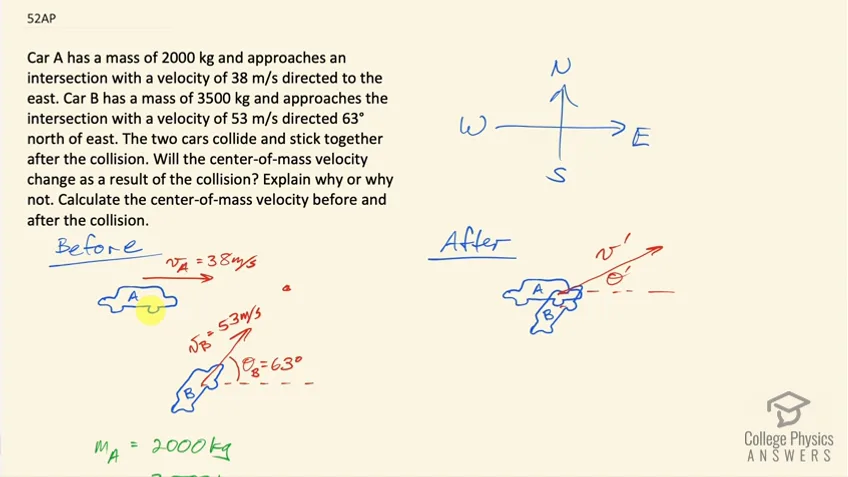 8:46PreviewProblem 52Full video with free trialCar A has a mass of 2000 kg and approaches an intersection with a velocity of 38 m/s directed to the east. Car B has a mass of 3500 kg and approaches the intersection with a velocity of 53 m/s directed 63° north of east. The two cars collide and stick together after the collision. Will the center-of-mass velocity change as a result of the collision? Explain why or why not. Calculate the center-of-mass velocity before and after the collision.